

Bird Friendly Coffee: How to Verify and Where to Buy
It is the most rigorous bird-conservation label available on a coffee bag today, and it is the one worth seeking out if protecting migratory bird habitat is your priority.
Three things you can do right now:
- Look for the official Smithsonian Bird Friendly® seal on the bag or product page.
- Visit the Smithsonian’s Where to Buy Bird Friendly Coffee list to find certified roasters and retailers in the U.S.
- Ask your local specialty shop or café to stock a Bird Friendly option — roasters respond to consumer demand.
Quick orientation before you read further:
- Bird Friendly is a double certification: organic baseline plus measurable habitat standards.
- “Shade-grown” printed on a bag is unregulated and carries no habitat guarantee on its own.
- The certification covers the full supply chain, from farm to roaster, so the cup you brew is 100% certified.
Key Takeaways
Bird Friendly® is the only coffee certification that combines USDA-recognized organic production with field-verified, science-based canopy and forest-structure metrics designed specifically to protect bird habitat.
| Point | Details |
|---|---|
| Double certification required | Bird Friendly demands organic certification plus measurable shade/canopy standards — no other label requires both. |
| Verify with the Smithsonian list | The official Where to Buy page is the only reliable way to confirm a roaster is currently certified. |
| “Shade-grown” is unregulated | The term carries no legal definition or third-party verification; treat it as a cue to ask more questions, not as a guarantee. |
| Expect a modest price premium | The premium supports farmer certification costs, annual inspections, and the conservation work the program funds. |
| Rowst for traceable specialty coffee | Rowst’s direct-sourced single-origin coffees offer full producer transparency for buyers who prioritize ethical sourcing. |
Table of Contents
- What does Bird Friendly coffee certification actually require?
- How does Bird Friendly differ from shade-grown, organic, and other labels?
- What are the real benefits for birds, farmers, and the land?
- Why scientists call Bird Friendly the gold standard
- How to identify and verify Bird Friendly coffee before you buy
- Where to buy Bird Friendly coffee in the United States
- Practical buying tips and red flags to watch for
- Why the certification gap matters more than most buyers realize
- Rowst sources specialty coffee with transparency at its core
- Sources
What does Bird Friendly coffee certification actually require?
The Smithsonian Migratory Bird Center (SMBC) developed Bird Friendly® in the 1990s after its scientists documented a direct link between coffee-farm habitat quality and migratory bird survival. The program’s requirements are published in the Bird Friendly Norms and go well beyond a marketing claim.
Organic first. Every Bird Friendly farm must hold a valid USDA-recognized organic certification before applying for Bird Friendly status. Organic is the floor, not the ceiling.
Epiphytes (plants that grow on other plants, like bromeliads and orchids) and some deadwood must be present, because both support insect populations that birds feed on.
Chain-of-custody from farm to bag. Bird Friendly coffee must be physically or temporally separated from non-certified beans at every processing stage: depulping, washing, drying, storage, transport, roasting, and marketing. Lots are marked “BF” so the coffee can be traced.
Annual third-party inspections. Certification is not a one-time award. A qualified third party inspects each farm every year, and full compliance is required to retain or renew status. Partial compliance is not enough.
Bird populations in the United States and Canada have declined by almost 30% — roughly 3 billion birds — since 1970, with habitat loss as a primary driver. The coffee farms where many migratory species overwinter are among the most critical habitats left.
Today, the program spans more than 4,000 farmers across 14 countries, producing over 36 million pounds of certified coffee annually. That scale is meaningful, though Bird Friendly still represents a small fraction of global coffee production.
How does Bird Friendly differ from shade-grown, organic, and other labels?
This is where most consumers get misled. The coffee aisle is full of certifications, and not all of them do the same work for birds.
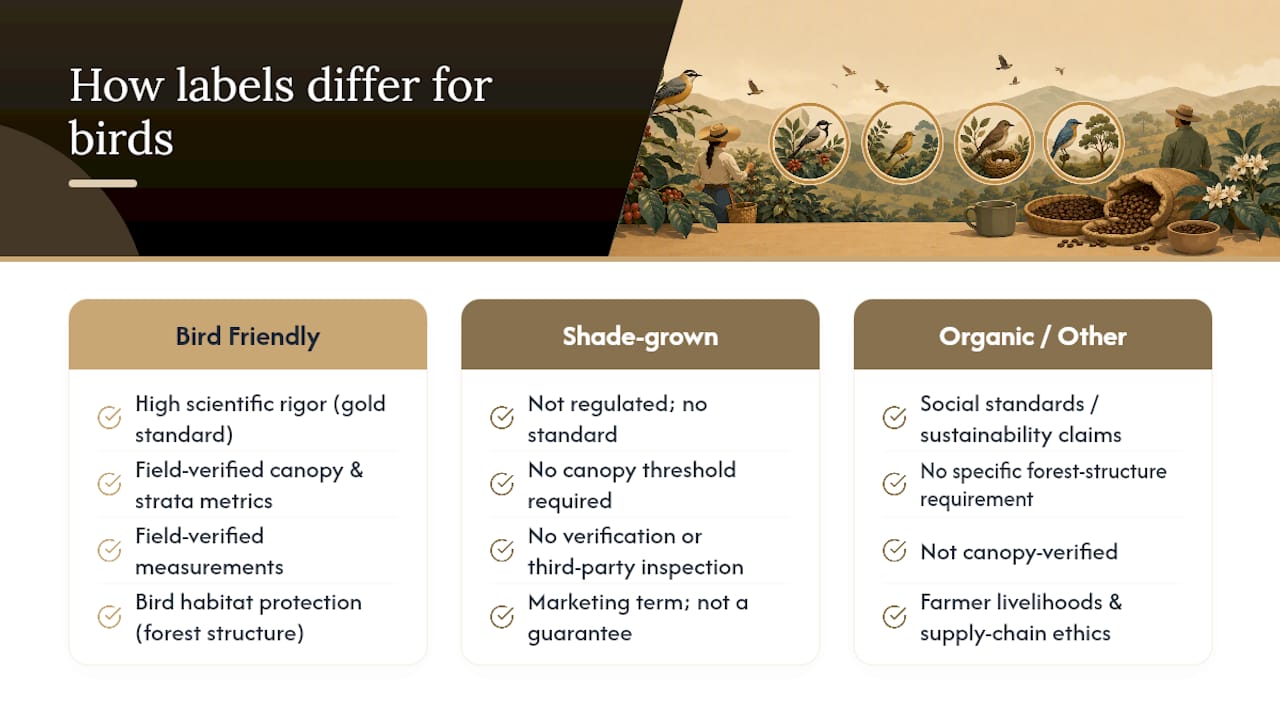
The key distinction is scientific rigor. Cornell Lab of Ornithology’s All About Birds calls Bird Friendly the “gold standard” precisely because it combines organic requirements with field-measured canopy metrics, rather than relying on social standards or generalized sustainability claims. Rainforest Alliance and Fair Trade serve important purposes, especially for farmer livelihoods and supply-chain ethics, but neither requires the specific forest structure that migratory birds depend on.
“Shade-grown” deserves special attention because it appears on many bags and sounds meaningful. It is not a regulated term. Any farm can print it without verification, third-party inspection, or any canopy threshold. Treat it as a conversation starter, not a guarantee.
Pro Tip: If your primary goal is bird habitat protection, Bird Friendly is the only label with the field-verified canopy and strata metrics to back that claim. If you also care about farmer wages and labor standards, look for Bird Friendly coffees that carry Fair Trade co-certification — some roasters offer both.
What are the real benefits for birds, farmers, and the land?
The shade-grown agroforestry systems that Bird Friendly requires do something sun-grown monocultures cannot: they function as working forests.
For birds and biodiversity:
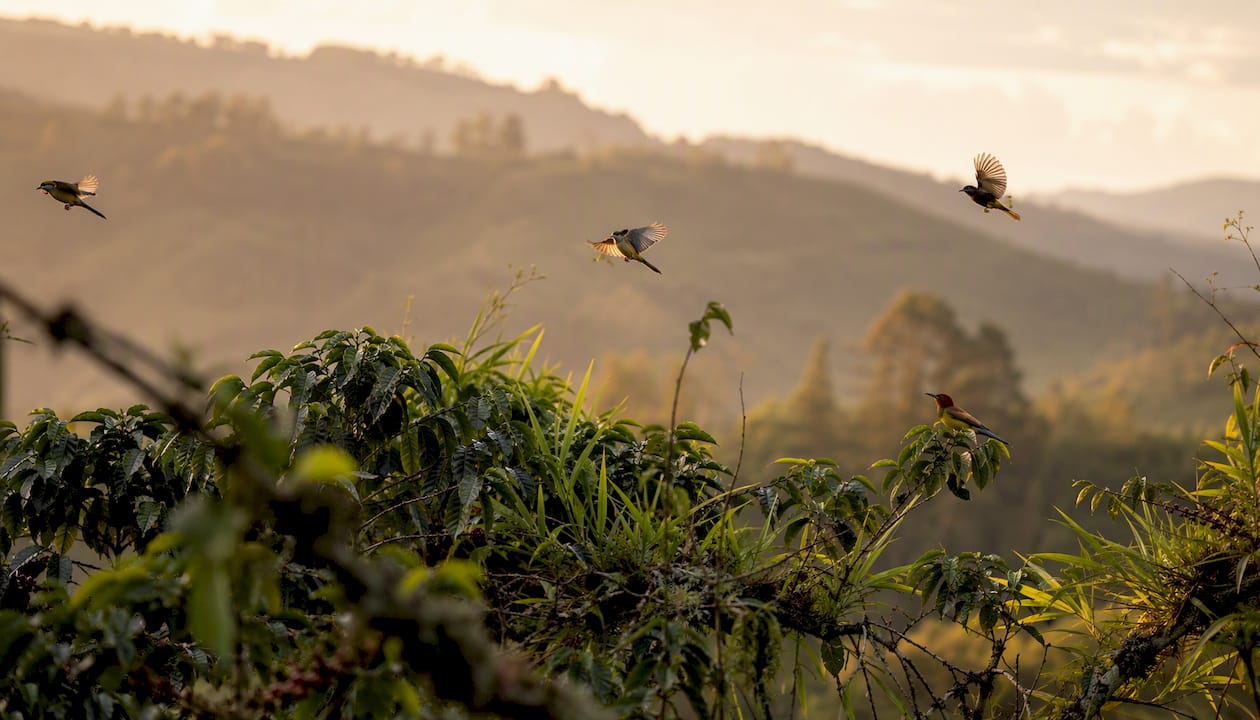
- Migratory warblers, tanagers, thrushes, and flycatchers use shade coffee farms as critical overwintering habitat across Latin America and the Caribbean.
- Multi-strata canopies support resident bird species year-round, not just migrants.
- Native tree diversity provides food sources (fruit, insects, nectar) across seasons.
- Epiphytes and deadwood support the invertebrate communities that insectivorous birds depend on.
For the land:
- Tree root systems reduce soil erosion on steep hillsides where much of the world’s coffee grows.
- Canopy cover moderates temperature and moisture, buffering farms against climate variability.
- Smithsonian research confirms that shade systems provide carbon sequestration, natural pest regulation through bird predation, and pollination services that reduce the need for chemical inputs.
For farmers:
- Shade trees produce fruit, timber, and other crops that diversify farm income beyond coffee.
- Coffee trees grown under shade tend to live longer and produce for more years than sun-grown plants.
- The Bird Friendly premium supports the additional costs of maintaining forest structure and undergoing annual certification audits.
The Audubon Society has long pointed to shade-grown and Bird Friendly systems as among the most practical tools for bird conservation outside of protected areas, because they preserve habitat on working agricultural land where formal protection is unlikely.
Why scientists call Bird Friendly the gold standard
The “gold standard” label is not marketing. It reflects specific program design choices that other certifications have not replicated.
“Bird Friendly is the only certification that requires both organic production and specific, research-based forest structure — making it the strongest available tool for protecting bird habitat on coffee farms.” Cornell Lab of Ornithology / All About Birds
Three features give scientists confidence in the label:
- Field-based, measurable criteria. The canopy cover minimum (40%), strata distribution requirement, and native-species thresholds are not self-reported. They are measured during annual third-party inspections.
- Organic as a prerequisite. Removing synthetic pesticides and fertilizers from the farm system is a condition of entry, not an optional add-on. This protects the invertebrate food web that birds rely on.
- 100% lot purity. The chain-of-custody rules mean that a bag labeled Bird Friendly contains only Bird Friendly coffee. No blending, no partial sourcing.
| Program metric | Figure |
|---|---|
| Certified farmers | More than 4,000 |
| Countries represented | 14 |
| Annual certified volume | Over 36 million pounds |
| U.S./Canada bird population decline since 1970 | ~30% (approx. 3 billion birds) |
These figures come directly from Smithsonian’s Bird Friendly program page. The 3-billion-bird decline statistic is the scientific backdrop the program was built to address.
How to identify and verify Bird Friendly coffee before you buy
Verification takes less than two minutes once you know what to look for. Here is the order of checks, from fastest to most thorough:
- Look for the Smithsonian Bird Friendly® seal. It features a stylized bird and the Smithsonian wordmark. No seal, no certification — regardless of what the copy says.
- Look for “BF” lot markings. On specialty roaster websites and some packaging, certified lots are marked “BF” to indicate chain-of-custody compliance per the Bird Friendly Norms.
- Confirm 100% sourcing. Ask the roaster directly: “Is this coffee 100% Bird Friendly certified, or is it a blend that includes some certified beans?” Only 100% certified lots carry the seal legitimately.
- For café purchases, ask the barista which roaster supplies their beans and whether that roaster is on the Smithsonian’s certified list. Many cafés do not know off the top of their heads — that question alone signals consumer demand.
Where to buy Bird Friendly coffee in the United States
Bird Friendly coffee is genuinely less common than Rainforest Alliance or Fair Trade products. You will rarely find it at a conventional grocery chain. The most reliable channels are:
Certified roasters’ online stores. This is the primary route. The Smithsonian’s Where to Buy list links directly to certified roasters who ship across the U.S. Buying direct from a roaster also gives you the freshest coffee and the clearest chain-of-custody documentation.
Specialty coffee shops. Independent shops that source from certified roasters sometimes carry Bird Friendly options, particularly in cities with active birding communities or strong sustainability cultures.
Museum and zoo gift shops. The Smithsonian’s own museum shops and some Audubon Society chapter stores stock certified options. These are often the most accessible physical retail locations.
Online marketplaces. A small number of certified roasters list on platforms like Amazon, though buying direct from the roaster’s own site is preferable for traceability.
Availability is growing but remains concentrated in the specialty segment. Expect to order online for the widest selection.
Practical buying tips and red flags to watch for
Price expectations. Bird Friendly coffee typically carries a modest premium over conventional specialty coffee. That premium covers the farmer’s certification costs, the annual third-party inspection, the additional labor of maintaining forest structure, and the Smithsonian’s program administration. The Smithsonian describes the premium as sometimes amounting to just a few cents per cup — a small cost relative to the conservation and ecological services it supports.
Red flags to avoid:
- “Shade-grown” with no certification seal or third-party verification.
- “Sustainably sourced” or “eco-friendly” with no named certification body.
- Blended coffees described as “contains Bird Friendly beans” — partial sourcing does not qualify for the seal.
- No origin information or lot traceability on the product page.
- A Bird Friendly claim that does not appear on the Smithsonian’s verified roaster list.
Practical tips:
- Prefer single-origin certified lots over blends — traceability is cleaner and the habitat story is specific.
- Buy directly from roasters when possible; they can answer questions about certification lot codes and farm origins.
- Check the roaster’s website for the current year’s certification status, since annual audits mean status can change.
Pro Tip: When shopping online, use Ctrl+F (or Cmd+F) to search the product page for “Bird Friendly” or “Smithsonian.” If neither term appears, the coffee is not certified regardless of other sustainability language on the page.
Why the certification gap matters more than most buyers realize
Most coffee drinkers who care about sustainability reach for the most visible label on the shelf. That is usually Rainforest Alliance, and it is not a bad choice. But there is a meaningful gap between “broadly sustainable” and “specifically designed to protect bird habitat,” and that gap is worth understanding.
The 3-billion-bird decline since 1970 is not an abstraction. Many of those species spend their winters on coffee farms in Mexico, Central America, and the Caribbean. The farm structure — how many trees, how tall, how diverse — determines whether those farms function as habitat or as green deserts. Bird Friendly’s canopy metrics exist precisely because Smithsonian scientists measured what structure birds actually need, then wrote those measurements into the certification criteria.
What strikes me about the program is its specificity. Most sustainability certifications are built around what is achievable at scale. Bird Friendly was built around what birds need. That inversion is rare, and it is why the Cornell Lab and Audubon treat it differently from other labels. Choosing it is a small act with a traceable ecological outcome — which is more than most consumer choices can claim.
Rowst sources specialty coffee with transparency at its core
Bird Friendly certification represents one of the most rigorous standards in ethical coffee sourcing. Rowst takes a complementary approach: building direct relationships with small-scale producers in Uganda, El Salvador, and Mexico, with no intermediaries between the farmer and your cup.
Rowst’s single-origin coffees are selected for traceability and quality, and every purchase directly rewards the producers who grow and sort each lot. While Rowst’s current offerings are not Bird Friendly certified, the brand’s commitment to direct sourcing and farmer transparency reflects the same values that make rigorous certification worth seeking out. If you want to explore specialty coffee with a clear provenance story, the Coffee Lover Pack is a curated starting point, or browse the full range at Rowst to find single-origin coffees from producers whose stories you can actually read.
Sources
- Norms for Production, Processing and Marketing of “Bird Friendly®” Coffee
- What’s the difference between shade‑grown, organic, fair‑trade, and Bird‑Friendly coffee?
- Smithsonian Migratory Bird Center’s Bird Friendly® Coffee Program Protects Migratory Birds and Supports Shade‑Grown Coffee Farms