

Whole Bean vs Ground: 4 Questions for Home Brewers' Morning Coffee
Whole bean coffee wins on flavor and shelf life for anyone willing to grind at home, and the gap is not subtle. Pre-ground coffee earns its place when speed matters more than nuance, when you don’t own a grinder, or when you buy small bags and finish them within a week. If flavor is the priority, buy whole bean and grind only what you need, ideally within days of roast.
TL;DR:
- Whole beans preserve volatile oils and aroma compounds for weeks if stored airtight and in darkness, unlike ground coffee that loses freshness within days.
- Grinding coffee exposes oils to oxygen, causing flavor decline; fresh grinding enhances brightness, acidity, and distinct notes, especially in light roasts and delicate coffees.
- Using a burr grinder with consistent grind size matched to your brew method prevents bitter or weak-tasting coffee, unlike inconsistent blade grinding.
- Store coffee in opaque, airtight containers away from heat and light, and buy smaller bags more frequently to minimize waste from stale coffee.
- For daily use and multiple brewing methods, whole beans with fresh grinding offer the best flavor, while pre-ground coffee suits quick mornings or occasional drinking.
Table of Contents
- Whole Bean vs Ground Coffee: Why Freshness Fades So Fast
- What Fresh Grinding Actually Does for Flavor
- How to Match Grind Size to Your Brew Method
- Storing Whole Bean and Ground Coffee the Right Way
- Weighing the Real Cost of Whole Bean vs Ground
- Which Should You Buy: A Quick Decision Checklist
- Why Rowst Recommends Whole Beans, and How to Start
- Crema and Texture: Where the Difference Shows Up Visually
- Packaging Waste: Whole Bean vs Ground Coffee’s Environmental Footprint
- Common Mistakes Shoppers Make Buying Pre-Ground Coffee
- A Personal Note on Sticking With Whole Bean
- Start With a Bag You’ll Actually Finish Fresh
- Sources
Whole Bean vs Ground Coffee: Why Freshness Fades So Fast
Grinding coffee tears open thousands of cell walls at once, exposing oils and volatile aroma compounds that were previously locked inside the bean. That exposure is exactly why ground coffee loses its fragrance within minutes of hitting the burrs, while whole beans hold onto those same compounds for weeks. Oxygen is the real enemy here, and surface area determines how fast it does its damage.
Roast date matters more than most shoppers realize, and so does the format the coffee sits in on your shelf. Rough freshness windows look like this:
- Sealed whole bean: Peak flavor lasts for several weeks past roast date, and remains drinkable beyond that period.
- Opened whole bean: Maintains solid flavor for a period of time if stored airtight.
- Sealed ground: Experiences noticeable flavor decline within a few days and becomes largely flat after some time.
- Opened ground: Aroma and brightness fade within 24 to 48 hours.
Pro Tip: Check the roast date, not the “best by” date, on any bag you buy. A “best by” stamp can sit a full year out and tells you nothing about how the coffee actually tastes today.
Even freshly roasted coffee that arrives pre-ground starts that clock the moment it left the grinder, which is often before it ever reached the warehouse.
What Fresh Grinding Actually Does for Flavor
The aroma compounds released at grinding are the same ones responsible for that bloom you see when hot water first hits fresh grounds. That bubbling reaction is carbon dioxide escaping alongside those volatile oils, and it’s a rough visual proxy for how much flavor is still locked inside the bean.
The sensory gap between whole bean ground fresh and coffee ground days earlier shows up most in:
- Light roasts and single-origin coffees, where delicate florals and fruit notes are the first things to disappear.
- Pour-over and drip methods, which rely on aromatics carried through steam and vapor rather than masked by heavy body.
- Espresso, where a weak or absent crema is often the first visible sign that beans have gone stale.
Taste the difference side by side and it’s not subtle: freshly ground coffee tends to taste brighter, with clearer acidity and distinct notes, like citrus in a washed Ethiopian or stone fruit in a Central American varietal. Coffee ground even a few days too early tends to flatten into something duller and often faintly papery, especially noticeable in lighter roasts where there’s less roast char to hide the staling.
How to Match Grind Size to Your Brew Method
Grind size controls how fast water pulls flavor out of coffee, and getting it wrong is one of the most common reasons a cup tastes bitter or watery. Here’s a quick reference for common methods:
- Espresso: Fine, close to powdered sugar, since water passes through in under 30 seconds under pressure.
- Pour-over: Medium, similar to coarse sand, for a slower, controlled drip.
- Drip machine: Medium, comparable to table salt, matched to standard filter baskets.
- AeroPress: Medium-fine, adjustable depending on steep time and desired strength.
- French press: Coarse, closer to breadcrumbs, so grounds don’t slip through the metal filter.
Consistency inside each of these ranges matters as much as hitting the right range in the first place. A burr grinder crushes beans evenly between two abrasive surfaces, while a blade grinder chops erratically, leaving a mix of fine dust and oversized chunks in the same batch. That inconsistency is why two cups from the same bag of blade-ground coffee can taste completely different from one another.
Pre-ground coffee works fine if you stick to one brewing method, buy the grind labeled for that method, and finish the bag quickly. The moment you own an AeroPress and a drip machine, though, a single pre-ground bag can’t serve both well.
Storing Whole Bean and Ground Coffee the Right Way
Both formats stale faster when exposed to light, heat, humidity, or strong odors, so the fundamentals are the same either way: an opaque, airtight container kept in a cool, dry cabinet, away from the stove and out of direct sun.
- Skip the clear canister on the counter. It looks nice; it also bakes your coffee in ambient light and heat all day.
- Buy bags with a one-way degassing valve if you can, so carbon dioxide escapes without letting oxygen in.
- Portion ground coffee into what you’ll use within a week, and keep the rest sealed.
On timing, roasters don’t all agree on how long beans need to rest before grinding. Depending on roast method, some beans are ready within 24 hours, while others benefit from resting a few days first to let excess carbon dioxide escape. You don’t need to wait weeks, and grinding a few days’ worth of beans at a time is a reasonable middle ground between daily grinding and grinding a whole bag on arrival.
Freezing is usually not worth the risk for everyday coffee. Freezer humidity and lingering food odors can contaminate beans, and repeated freeze-thaw cycles introduce moisture that accelerates staling. If you must freeze a large bag for long-term storage, vacuum seal it in a single-use portion and never refreeze what’s thawed.
Weighing the Real Cost of Whole Bean vs Ground
A decent burr grinder runs anywhere from $30 for an entry-level hand grinder to well over $150 for a quality electric model, plus a scale if you want repeatable dosing. Pre-ground coffee skips that investment entirely, which is the honest appeal for casual drinkers.
The tradeoff shows up daily, not just at checkout:
- Grinding takes an extra minute or two each morning, plus occasional cleaning to keep burrs free of oil buildup.
- Pre-ground coffee is ready the second you open the bag, with zero learning curve on dose or grind size.
- A middle path works for many households: grind a few days’ supply at once, buy smaller whole-bean bags so nothing sits opened too long, and keep pre-ground on hand only for travel or backup.
Which Should You Buy: A Quick Decision Checklist
Answer a few honest questions about your routine and the choice usually becomes obvious.
- Do you brew coffee daily? Frequent drinkers get the most value from whole bean, since the flavor gain compounds every single cup.
- Do you own a grinder, or use more than one brew method? Either answer alone tips things toward whole bean and an adjustable burr grinder, which saves money over buying separate pre-ground bags for each method.
- Do you need coffee moving fast every morning with zero extra steps? Pre-ground, in a small bag you’ll finish within a week, is the realistic answer.
- Do you drink coffee only occasionally? Buy pre-ground in small quantities and store it airtight rather than let a large whole-bean bag go stale untouched.
| Your profile | Recommended format | Why |
|---|---|---|
| Daily home brewer, one method | Whole bean, grind fresh daily or every few days | Best flavor return for consistent use |
| Multi-method home barista | Whole bean plus adjustable burr grinder | One bag serves espresso, pour-over, and drip |
| Fast commuter mornings | Small pre-ground bag, sealed tight | Speed without buying more than you’ll use |
| Occasional drinker | Small pre-ground bag | Avoids a large whole-bean bag going stale |
Buy a 250g whole-bean bag and a mid-range grinder if flavor is your priority, keep small pre-ground bags for travel, and let your actual morning routine decide the split.
Why Rowst Recommends Whole Beans, and How to Start
Rowst sources single-origin specialty coffee directly from small-scale farmers, which means the beans arriving at your door were picked and sorted with a specific cup profile in mind, not blended down to mask inconsistency. That level of care is largely wasted if the coffee sits pre-ground on a shelf losing aroma before it ever reaches your kettle.
For readers testing this out, low-friction entry points make sense:
- A discovery pack lets you sample several origins, like Uganda, El Salvador, and Mexico, without committing to a single full bag.
- A single-origin 250g bag is small enough to finish while it’s still near peak flavor, which sidesteps the staling problem entirely.
- Choosing a roast level suited to your brew method (lighter for pour-over, slightly darker for espresso) avoids the mismatch that leads to disappointing cups.
Crema and Texture: Where the Difference Shows Up Visually
Crema, that reddish-brown foam sitting on top of a well-pulled espresso shot, comes from carbon dioxide and oils emulsifying under pressure as hot water forces its way through the puck. Both of those elements, gas and oil, are exactly what fresh whole beans still have in abundance and stale pre-ground coffee has largely lost.
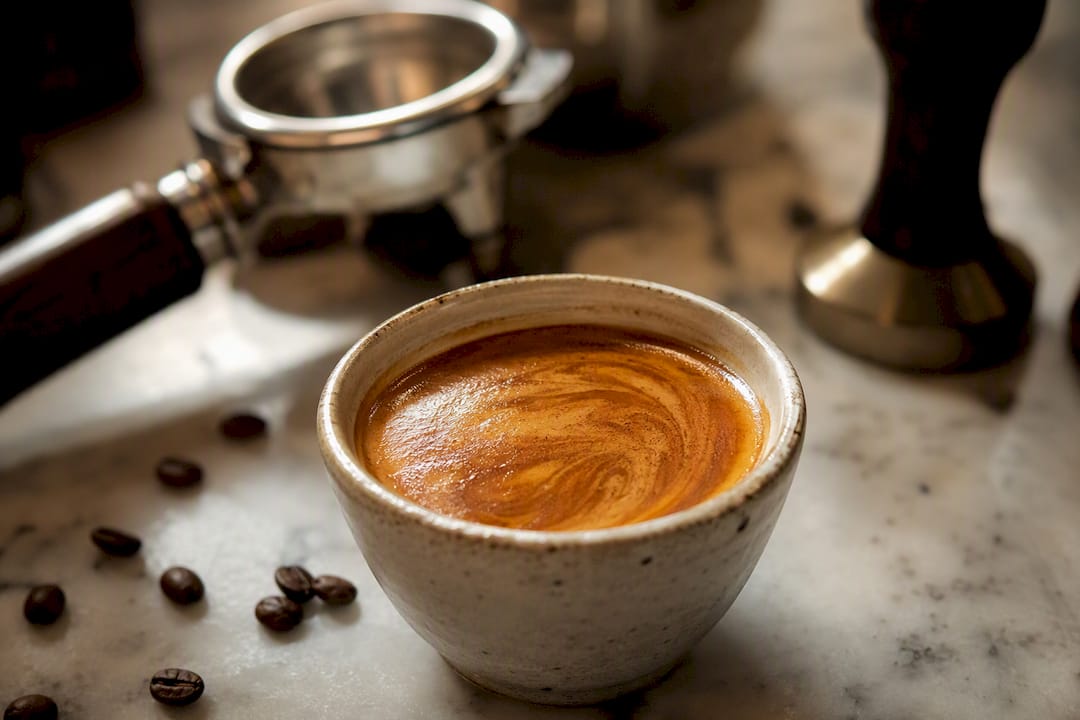
A shot pulled from beans ground moments earlier typically produces a thick, persistent crema with a marbled tiger-striping pattern, and it holds for a minute or more before dissipating. The same espresso recipe run on coffee that was ground days or weeks ago tends to produce a thin, pale layer that vanishes almost immediately, or in badly stale cases, no crema at all. That’s not just cosmetic. Crema carries a meaningful share of the aromatic intensity you smell right as the cup is set in front of you.
Texture tells a similar story outside of espresso. Fresh grounds in a French press or AeroPress produce a noticeably more vigorous bloom, thicker body, and a rounder mouthfeel, since the oils that carry body haven’t oxidized into something thinner and flatter. Stale grounds, even good beans ground too far ahead, tend to produce a cup that feels watery despite an identical recipe. If you’ve ever wondered why the same bag of coffee tasted incredible on day one and forgettable by day ten, the crema and body loss are usually the most visible fingerprints of that decline.
Packaging Waste: Whole Bean vs Ground Coffee’s Environmental Footprint
Both formats typically ship in similar multilayer bags designed to block oxygen, light, and moisture, so the packaging materials themselves aren’t wildly different between whole bean and ground. The real environmental distinction comes down to how the coffee is actually used once it’s in your kitchen.
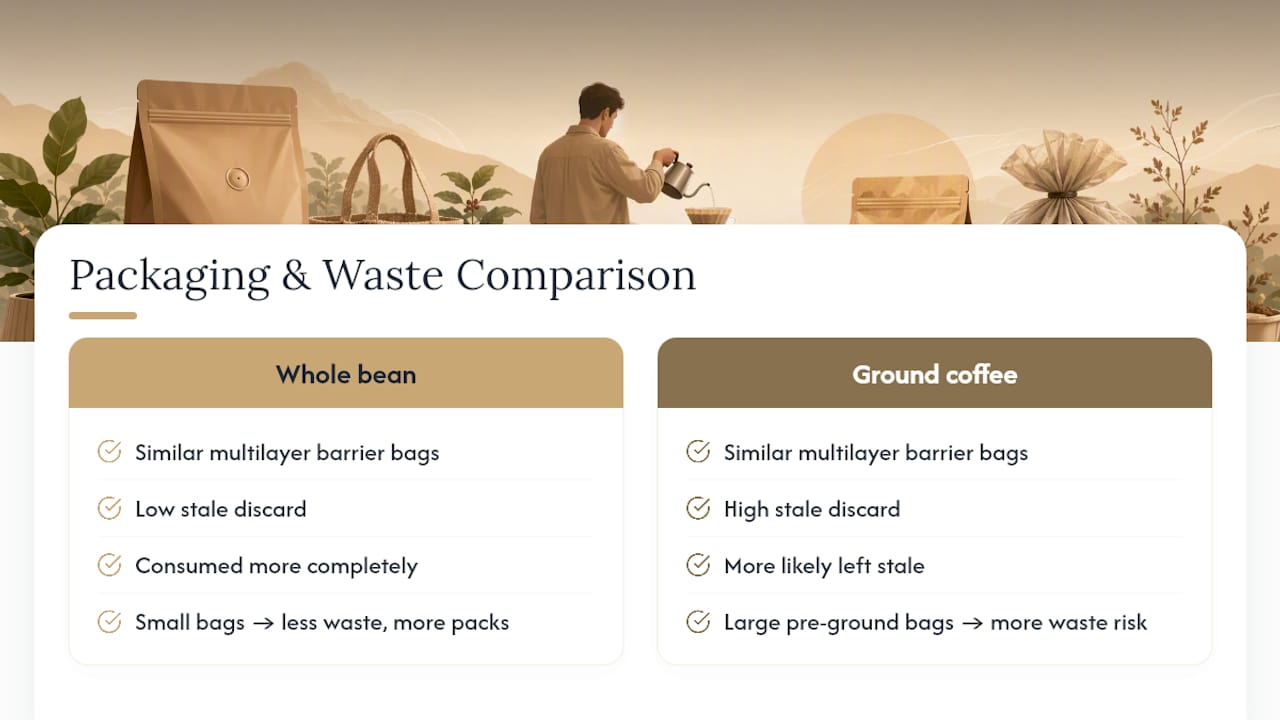
Ground coffee that stales before you finish the bag represents wasted resources on every level, water, land, farm labor, shipping fuel, that went into growing and processing beans that end up tossed rather than enjoyed. Whole bean coffee, ground only as needed, tends to get consumed more completely because you’re less likely to let a fresher-tasting bag sit forgotten in the cabinet.
Buying smaller bags more frequently also cuts down on the odds of throwing out stale coffee, though it can mean slightly more packaging per unit of coffee overall compared to one large bag. The tradeoff is worth considering: a large bag of pre-ground coffee that goes half-stale before you finish it wastes both the packaging and the coffee inside it, while a smaller whole-bean bag fully consumed while fresh wastes neither.
Roasters who prioritize freshness over shelf stability, buying from farmers directly and roasting in smaller batches, also tend to move product faster, which reduces the odds of coffee sitting in warehouse storage for months before it reaches a shelf.
Common Mistakes Shoppers Make Buying Pre-Ground Coffee
Pre-ground coffee isn’t inherently bad. Most disappointing cups trace back to a handful of avoidable buying mistakes rather than the format itself.
- Ignoring the roast date entirely. A bag with no visible roast date, or one buried in fine print, is often coffee that’s already been sitting for months.
- Buying the wrong grind for your method. A bag labeled “drip grind” run through an espresso machine will taste sour and weak no matter how good the beans were originally.
- Buying large bags to save money. A one-pound bag of ground coffee that takes six weeks to finish is stale for most of that time, even if the per-ounce price looked better at checkout.
- Storing the bag in its original packaging after opening. Many pre-ground bags aren’t resealed well once cut open, letting air in daily.
- Assuming darker roasts hide staleness better. They mask some flaws, but a stale dark roast still tastes flat and bitter rather than rich.
The fix for most of these is simple: buy smaller quantities more often, check the roast date the way you’d check an expiration date on milk, and match the grind label to your actual brewer before you check out.
A Personal Note on Sticking With Whole Bean
Grinding a few days’ worth of beans at a time struck the right balance for me between flavor and convenience. It only adds a minute to the morning routine, and the payoff in aroma is worth it every time. Try your own three-day test: brew the same bean as whole bean ground fresh, then as pre-ground from an already-opened bag, side by side. Taste the difference yourself, and let us know what you notice.
— Diego
Start With a Bag You’ll Actually Finish Fresh
Rowst makes trying whole bean simple, without asking you to commit to a pound of coffee you might not finish while it’s still good. The Coffee Lover Pack is the easiest starting point if you want to compare origins side by side, since it’s built specifically for that kind of tasting curiosity. If you already know you lean toward bold, structured cups, the El Salvador Pacamara is a strong single-origin pick to start with.
A couple of buying habits will help regardless of which you choose: pick a roast level that matches your brew method (lighter for pour-over, medium for drip, and something with more body for espresso), and buy a smaller bag more often rather than a large one that sits half-finished for a month. Grab a 250g bag, grind what you need this week, and taste what fresh actually means. That’s the whole point of drinking coffee this way.