

Arabica vs Robusta: The Real Differences Explained
If you want a sweeter, brighter cup that highlights origin character, choose Arabica; if you want a bolder, more bitter cup with roughly double the caffeine and a lower price, Robusta or a Robusta blend does the job. The two species split coffee’s identity almost entirely: Arabica claims the specialty world, Robusta anchors instant coffee and traditional espresso crema, and Rowst builds its entire catalog around single-origin Arabica for exactly that reason.
TL;DR:
- Robusta has roughly double the caffeine content of Arabica, making it ideal for those seeking a more bitter, intense, and stimulating cup.
- Arabica grows at high elevations under more fragile conditions, resulting in a higher price due to greater labor and vulnerability, unlike Robusta which is hardier and cheaper to produce.
- Robusta’s heavier body and higher chlorogenic acid content produce a distinct, often grainy or woody flavor profile that suits espresso blends and instant coffee.
- Brewing method impacts the flavor more than species, with Arabica favored for pour-over and filter brewing to highlight its acidity and aromatics.
- Direct-trade sourcing of Arabica from small farms emphasizes transparency and origin traceability, whereas Robusta is predominantly used in budget blends and commodity markets.
Table of Contents
- Arabica vs Robusta: Quick Facts at a Glance
- Robusta vs Arabica Taste: What Actually Shows Up in Your Cup
- Which Coffee Is Stronger: Caffeine, Sugar, and Acid Breakdown
- Growing Conditions, Yield, and Why Arabica Costs More
- Espresso Roast vs Filter Roast: How Brewing Changes the Comparison
- How to Choose Between Arabica and Robusta for Your Brew
- The Environmental Tradeoffs Behind Every Bag of Coffee
- Genetic Differences and Botanical Characteristics
- Historical and Geographical Origins of Arabica and Robusta
- Why Rowst Chooses to Work Almost Exclusively With Arabica
- Shop Rowst: Curated Arabica Options and Discovery Packs
- Sources
Arabica vs Robusta: Quick Facts at a Glance
The numbers below explain most of what you taste in the cup before you even consider roast or brew method.
| Trait | Arabica | Robusta |
|---|---|---|
| Caffeine content | ~1.2% to 1.5% | ~2.2% to 2.7% |
| Sugar and lipid content | Higher | Lower |
| Chlorogenic acid (CGA) | Lower | Higher |
| Acidity and body | Bright, lighter body | Flat, heavier body |
| Typical growing altitude | high elevations typical of tropical highlands | lower elevation tropical regions |
| Price relative to Arabica | Baseline (higher) | Roughly 60% to 80% of Arabica commodity price |
| Common uses | Specialty, filter, single-origin | Instant, commodity blends, espresso crema |
If you’re chasing clarity in a pour-over, look at the sugar and acidity rows. If you’re chasing a cheap, caffeinated wake-up cup, the caffeine and price rows tell you where Robusta earns its keep.
Robusta vs Arabica Taste: What Actually Shows Up in Your Cup
Arabica’s flavor identity runs on acidity. Well-processed lots deliver notes that read as citrus, stone fruit, florals, or milk chocolate, depending on origin and elevation. That brightness is exactly why filter brewing and single-origin pour-overs favor Arabica: slower extraction lets those delicate top notes survive without getting buried.
Robusta reads differently in the cup. Expect a heavier, almost syrupy body with nutty or grainy tones, and, in lower-grade lots, a rubbery or woody bitterness that Arabica rarely produces. That’s not automatically a flaw. Industry data shows many traditional Italian espresso blends include 10% to 30% Robusta precisely for the body and crema persistence it adds, while Vietnamese iced coffee leans on Robusta’s intensity to stand up to sweetened condensed milk.
Where each shines:
- Espresso and milk drinks: a touch of Robusta thickens body and crema without drowning out the shot’s sweetness.
- Vietnamese iced coffee: Robusta’s bitterness balances condensed milk instead of getting lost under it.
- Pour-over and single-origin filter: Arabica’s acidity and aromatics need the gentler extraction filter brewing provides.
Species alone doesn’t guarantee quality. Farming, processing, and roasting decisions still separate a mediocre Arabica from an exceptional one.
Which Coffee Is Stronger: Caffeine, Sugar, and Acid Breakdown
“Stronger” usually means two different things: caffeine punch and bitterness. Robusta wins both, and the chemistry explains why.
Pro Tip: If a “strong” cup to you means jittery and bitter, Robusta delivers. If it means intensely flavorful but smooth, look for a well-processed Arabica instead.
- Arabica averages 1.2% to 1.5% caffeine by dry weight; Robusta runs 2.2% to 2.7%, close to double.
- Arabica carries more sugar and lipid content, the raw material for sweetness and aromatic complexity after roasting.
- Robusta carries significantly more chlorogenic acid (CGA), a compound that breaks down during roasting into bitter, sometimes harsh-tasting byproducts.
That higher caffeine and CGA load isn’t accidental. Both compounds function as natural pest deterrents, which is part of why Robusta plants shrug off insects and disease that would devastate an Arabica field.
Growing Conditions, Yield, and Why Arabica Costs More
Arabica needs elevation, typically 3,000 to 6,500 feet, along with stable temperatures and consistent rainfall. That fragility comes with a cost: Arabica plants are more vulnerable to leaf rust and pests, which means more labor, more losses, and more careful hand-picking at harvest.
Robusta tolerates heat, humidity, and lower elevations, often thriving from sea level up to 2,000 feet. It resists disease better and yields more cherries per tree, which is the main reason it’s cheaper to farm and buy.
- Arabica: high-altitude, disease-prone, labor-intensive, lower yield per hectare.
- Robusta: lowland-tolerant, disease-resistant, higher yield, lower production cost.
- Commodity data shows Robusta typically trades at 60% to 80% of Arabica’s price in a given year.
That price gap explains the market split. Arabica dominates specialty coffee, while Robusta remains the backbone of instant coffee, budget blends, and a good share of the world’s espresso.
Espresso Roast vs Filter Roast: How Brewing Changes the Comparison
Roasting can narrow or widen the gap between these two species more than most drinkers realize. Filter roasts tend to stop earlier and lighter, preserving the acidity and aromatics that make Arabica worth seeking out as a single-origin. Espresso roasts, by contrast, often push development time longer to increase solubility, since espresso needs more soluble, well-developed beans to extract properly under pressure in a short shot.
Brew mechanics matter just as much as roast level. A finer grind, longer contact time, and higher pressure all pull more compounds out of the grounds, including the bitter ones. That’s why a Robusta-heavy espresso can taste rounder than the same beans brewed as filter coffee, and why an underdeveloped Arabica espresso can taste sour and thin.
Four practical adjustments for home brewers:
- Match roast to method. Buy a filter-specific roast for pour-over and an espresso roast if you’re pulling shots. They’re rarely interchangeable.
- Grind coarser for Robusta-heavy blends. Its heavier body and bitterness intensify fast at a fine grind.
- Shorten contact time on high-CGA beans. Cutting brew time slightly can tame excess bitterness without sacrificing strength.
- Adjust dose before you adjust grind. If a cup tastes harsh, try a lower dose first. It’s a faster fix than dialing in grind size from scratch.
How to Choose Between Arabica and Robusta for Your Brew
Your brew method should drive the decision more than any general reputation about which species is “better.”
- Pour-over or drip: choose Arabica, ideally a single-origin, to get the acidity and clarity filter brewing is built to showcase.
- French press: Arabica still works well here since the immersion method flatters body without needing Robusta’s extra weight.
- Espresso for milk drinks: a blend with 10% to 30% Robusta adds body and crema stability that pure Arabica sometimes lacks.
- Vietnamese iced coffee: Robusta is traditional and holds up better against sweetened condensed milk.
- Instant coffee or tight budget: Robusta or Robusta-heavy blends deliver caffeine and intensity at a lower cost per cup.
When shopping, check three things before you buy: the roast level listed on the bag, whether it’s single-origin or a blend, and whether the label names actual tasting notes rather than vague marketing language. A bag naming its origin, elevation, and processing method is telling you the producer had nothing to hide.
The Environmental Tradeoffs Behind Every Bag of Coffee
Growing conditions don’t just shape flavor and price. They shape land use, water demand, and biodiversity outcomes on the farms that grow each species.
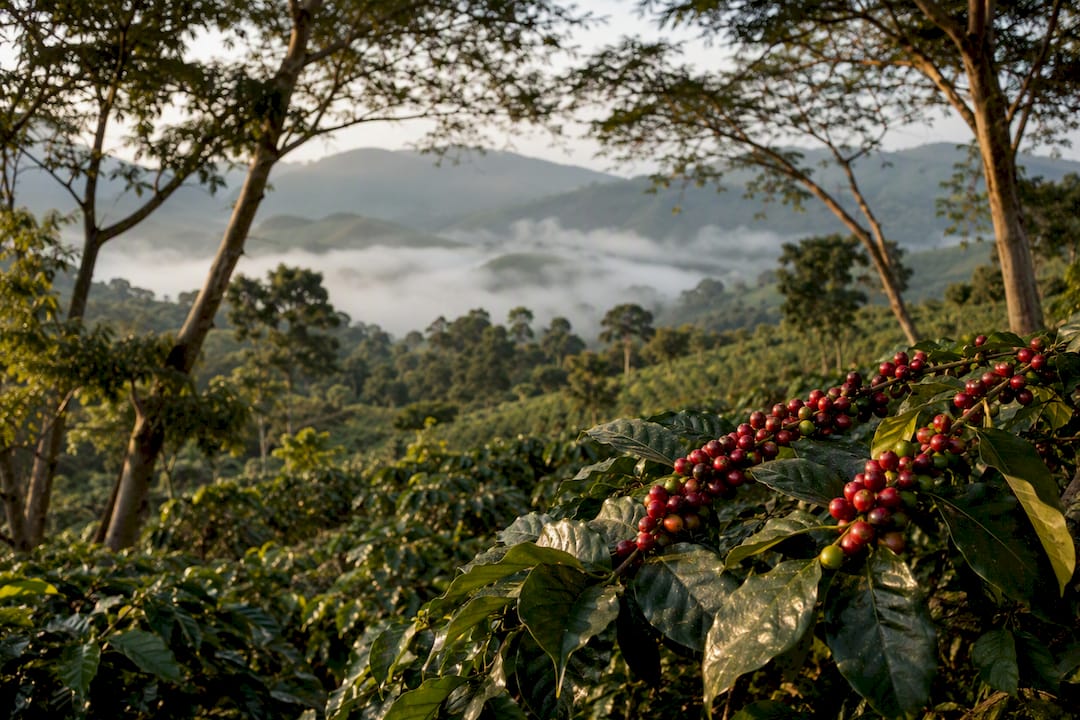
Arabica traditionally grows under shade canopy at higher elevations, a system that supports bird habitat and slows soil erosion on steep terrain. But that same fragility, its sensitivity to disease and temperature swings, pushes some farmers toward heavier fungicide and fertilizer use to protect a crop that can fail with a single bad season. Climate shifts are also squeezing the narrow altitude band Arabica needs, forcing some growers higher up mountainsides where farmable land is limited.
Robusta’s hardiness cuts input use in places where it thrives without much intervention, but its tolerance for lowland, cleared terrain has also made it a driver of deforestation in parts of Southeast Asia and West Africa, where forest gets converted to sun-grown plantations. Sun cultivation raises yield but strips out the shade-tree ecosystems that shade-grown Arabica preserves.
Neither species has a clean sustainability record on its own. What matters more is how a specific farm manages water, shade, and chemical inputs, which is exactly why direct-trade sourcing that lets a buyer see the actual farm and practices behind a bag carries more weight than a species label ever could.
Genetic Differences and Botanical Characteristics
The most fundamental difference between these two coffees isn’t flavor. It’s chromosomes. Coffea arabica is tetraploid, carrying four sets of chromosomes, while Coffea canephora (Robusta) is diploid with two. That genetic structure makes Arabica naturally self-pollinating and far less genetically diverse, which is part of why it’s more vulnerable to pests and disease. Robusta’s diploid structure and cross-pollinating habit give it broader genetic variation and, in turn, hardier field performance.
Physically, the plants look different at a glance. Arabica grows as a smaller shrub with elongated, flattish, oval-shaped beans and matures slower on the branch. Robusta grows taller and more vigorously, produces rounder beans, and ripens faster, contributing to its higher yield per tree. Arabica cherries also contain roughly half the caffeine and CGA of Robusta cherries, a chemical difference rooted directly in that genetic gap, since both compounds serve as the plant’s built-in pest defense.
Hybrid varieties exist that blend traits from both species, but they remain a small share of global production. For nearly all commercial coffee, the arabica-robusta split still defines the plant you’re drinking, long before roast or brew method ever enters the picture.
Historical and Geographical Origins of Arabica and Robusta
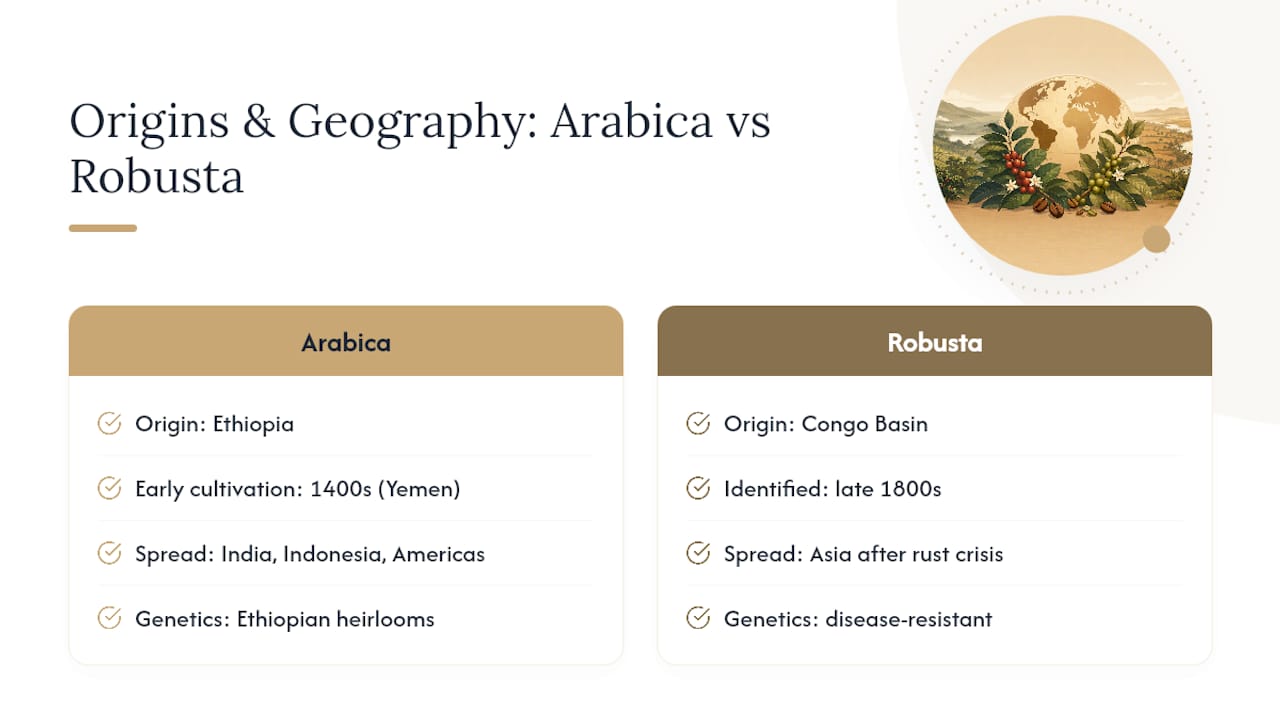
Arabica’s story starts in the highland forests of Ethiopia, where it grew wild for centuries before cultivation spread it through Yemen and the Arabian Peninsula by the 1400s. From there it traveled with traders and colonists to India, Indonesia, and eventually the Americas, where volcanic highlands in Latin America turned out to be ideal for it. That migration is why so much of today’s specialty Arabica traces back to Ethiopian heirloom genetics, even when the beans in your bag were grown in Central America or East Africa.
Robusta has a shorter, more recent history. It was identified growing wild in the Congo Basin in the late 1800s, far later than Arabica’s documented cultivation. Its resistance to coffee leaf rust made it a practical replacement crop after the disease devastated Arabica plantations across parts of Asia in the late 19th century, particularly in what was then Dutch-controlled Indonesia. That crisis is the real reason Robusta became a global commodity: farmers needed something that wouldn’t die when Arabica did.
Today Vietnam has become the world’s dominant Robusta producer, a position it built over just a few decades, while Brazil and Colombia anchor Arabica’s global supply. The geography still tells the deeper story: Arabica needs the cool, high-altitude conditions of equatorial mountains, while Robusta thrives in the hot, humid lowlands those same regions can’t otherwise use for coffee at all.
Why Rowst Chooses to Work Almost Exclusively With Arabica
Rowst built its entire selection around single-origin Arabica because clarity matters more than volume. Working directly with small-scale producers in places like Uganda, El Salvador, and Mexico lets us trace flavor back to a specific farm, altitude, and processing method rather than a blended commodity average. Our discovery packs exist so you can taste that origin variation for yourself, side by side, in your own kitchen.
— Diego
Shop Rowst: Curated Arabica Options and Discovery Packs
Rowst gives you a faster path to the flavor differences this guide just walked through, without hunting through dozens of bags trying to decode vague tasting notes. Every coffee we sell is single-origin Arabica, sourced directly from the small farms that grew it, so what’s on the label is what’s actually in the bag.
If you want to taste the range this article describes, start with the Coffee Lover Pack, which lets you compare several Arabica origins and roast styles in one order. Prefer to explore a single region first? Try the Uganda Bugisu for its bright, fruit-forward profile, or the Mexico Veracruz for something rounder and more chocolatey. Browse the full lineup at Rowst and pick the origin that matches the cup you’ve been chasing.
Sources
- Pulled Journal — Robusta vs Arabica: Why It Actually Matters for Your Cup
- Food & Wine — Arabica and Robusta: the best grown coffee bean species
- Perfect Daily Grind — Roasting for filter coffee vs for espresso
- ITA Coffee — Arabica vs Robusta: Botanical and chemical differences