

Ethically Sourced Coffee: What It Means and How to Buy It
Ethically sourced coffee is coffee whose supply chain offers traceability back to a named farm or cooperative, credible protections for worker rights or farmer incomes, and documented environmental safeguards. That definition matters at the moment of purchase because it separates verified claims from marketing language. Three checkpoints help you cut through the noise right now:
- Check for traceability. Does the bag or product page name the farm, cooperative, or region of origin? A named producer is a starting point for verification.
- Look for a recognized certification or price guarantee. Labels from Fairtrade International / Fair Trade USA, Rainforest Alliance, or USDA Organic signal that an independent body has audited the claims.
- Seek transparency. Does the company publish sourcing reports, audit results, or payment terms? Silence on those questions is itself informative.
Rowst, a specialty roaster with direct relationships with small-scale producers in Uganda, El Salvador, and Mexico, is the case study woven through this guide. Its product pages illustrate exactly what verifiable sourcing evidence looks like in practice.
Key Takeaways
Ethically sourced coffee requires traceability to a named producer, credible third-party price or labor protections, and environmental standards you can verify before you buy.
| Point | Details |
|---|---|
| Certifications vary significantly | Fairtrade guarantees a $1.80/lb minimum price; Rainforest Alliance uses an assess-and-address model with no price floor. |
| Traceability is the baseline | Named farms, cooperatives, harvest dates, and lot details are the clearest signals of genuine supply chain visibility. |
| “Direct trade” is unregulated | Without third-party verification, marketing terms like “direct trade” or “shade grown” carry no enforceable standard. |
| Price alone proves nothing | A higher price tag without sourcing documentation is not evidence of ethical sourcing; use the verification checklist instead. |
| Rowst offers verifiable sourcing | Rowst’s single-origin product pages name origins, varieties, and producers, with direct farmer relationships and no intermediaries. |
Table of Contents
- Why ethical sourcing matters for farmers, workers, and ecosystems
- What common certifications and labels actually guarantee
- How to verify roaster claims on packaging and websites
- A decision framework and price expectations for buying ethically sourced coffee
- Common myths, misleading terms, and tradeoffs to watch for
- How Rowst sources ethically — applying the verification checklist
- What buying ethically sourced coffee actually requires of us
- Rowst makes ethically sourced specialty coffee easy to find
- Sources
Why ethical sourcing matters for farmers, workers, and ecosystems
Coffee touches an extraordinary number of lives. According to the ILO-led CLEAR Supply Chains project, the sector provides livelihoods for 20–25 million farming families and involves over 100 million people across producing and processing countries. Roughly 73% of global coffee is grown by smallholders, the farmers most exposed to price volatility and least able to absorb a bad harvest or a market crash.
73% of global coffee is produced by smallholders — the farmers most vulnerable to price swings and least likely to benefit from conventional commodity pricing.
When commodity prices fall below the cost of production, the consequences are not abstract. Families pull children out of school to work the harvest. Debt accumulates. Farms are abandoned. The U.S. Department of Labor’s list of goods produced by child or forced labor includes coffee, with documented reports of forced labor and child labor in Brazilian states such as Minas Gerais and São Paulo. Brazil is the world’s largest coffee producer, which means the risk is embedded in mainstream supply chains, not just fringe origins.
The environmental stakes are equally concrete. Shade-grown coffee forests support biodiversity and sequester carbon; when farmers convert to sun-grown monocultures to maximize yield, bird habitat and soil health decline together. Ethical sourcing practices, when genuinely implemented, address these pressures through price floors, labor audits, and environmental standards.
Your purchasing choices carry real weight. Daily coffee consumption in the U.S. recently reached a 20-year high, according to the National Coffee Association, which means American buyers collectively represent one of the most powerful market signals in the global coffee trade.
What common certifications and labels actually guarantee
Not all labels are created equal. Each certification program has a different focus, a different audit structure, and real limits worth understanding before you rely on it.
Fairtrade / Fair Trade USA
Core claim: A guaranteed minimum price and a community development premium paid to certified cooperatives.
What is audited: The Fairtrade Minimum Price functions as a safety net calculated from producer cost-of-production data and stakeholder consultation. For washed Arabica, Fairtrade raised the minimum price to $1.80/lb effective August 1, 2023, as part of an ongoing price review. A separate Fairtrade Premium (currently $0.20/lb for conventional, $0.30/lb for organic) goes directly to the cooperative for community projects. Third-party auditors verify compliance annually.
Practical limit: The minimum price does not automatically deliver a living income. It is a floor, not a ceiling, and cooperatives still negotiate above-floor prices when market conditions allow.
Rainforest Alliance
Core claim: Environmental sustainability and responsible farming practices, with human-rights due diligence built in.
What is audited: The Rainforest Alliance assurance system uses an assess-and-address model: farms are evaluated for risks, required to remediate identified issues, and monitored over time. This is a due-diligence framework rather than a zero-tolerance removal policy.
Practical limit: No guaranteed minimum price. Labor protections depend on the quality of the audit and the remediation follow-through.
USDA Organic
Core claim: No synthetic pesticides, herbicides, or fertilizers in production.
What is audited: Soil and input management practices, with annual inspections by USDA-accredited certifiers. Organic certification is rigorous on agricultural inputs.
Practical limit: No labor standards, no price floor. A bag can be certified organic and still come from a farm with poor working conditions.
Bird-Friendly (Smithsonian Migratory Bird Center)
Core claim: Coffee grown under a certified shade canopy that supports migratory bird habitat.
What is audited: Canopy height, tree diversity, and foliage cover, verified by on-site inspection. Bird-Friendly certification also requires USDA Organic as a baseline, making it one of the most rigorous combined environmental signals available.
Practical limit: No labor or price standards. Strong on habitat; silent on farmer income.
C.A.F.E. Practices
Core claim: A corporate sourcing verification program with economic, social, and environmental indicators.
What is audited: SCS Global Services lists the third-party auditors approved to verify C.A.F.E. Practices suppliers. Farms are scored against a set of indicators, and suppliers must meet a minimum threshold to qualify.
Practical limit: This is a corporate verification scheme, not an independent certification in the same legal sense as Fairtrade or USDA Organic. The program is designed and governed by one company, which limits its independence.
| Certification | Price floor / premium | Labor standards | Environmental standards | Third-party verified |
|---|---|---|---|---|
| Fairtrade | Guaranteed minimum price and premium as per Fairtrade standards source | Yes (cooperative audits) | Yes (basic) | Yes (independent) |
| Rainforest Alliance | No guaranteed minimum price | Assess-and-address approach | Yes (strong) | Yes (independent) |
| USDA Organic | No price floor | No labor standards | Yes (inputs only) | Yes (USDA-accredited) |
| Bird-Friendly | No price floor | No labor standards | Yes (rigorous shade and organic standards) | Yes (Smithsonian) |
| C.A.F.E. Practices | No price floor | Yes (scored) | Yes (scored) | Yes (corporate verification) |
Pro Tip: Pairing Fairtrade with USDA Organic gives you both a price floor and verified agricultural practices. Bird-Friendly already requires organic as a baseline, so that single label covers both environmental dimensions at once.
How to verify roaster claims on packaging and websites
A certification seal is a starting point, not a conclusion. Here is what to look for beyond the logo:
- Percent certified. Some bags carry a certification logo even when only a portion of the blend is certified. Look for language like “100% Fairtrade” versus “contains Fairtrade certified coffee.” The difference matters.
- Farm or cooperative names. A roaster confident in its sourcing names the producer. Vague origin descriptions (“Central America blend”) signal a commodity supply chain.
- Lot-level traceability. Micro-lot or single-lot descriptions, harvest dates, and processing details (washed, natural, honey) indicate the roaster has genuine visibility into the supply chain.
- Third-party audit reports. Look for downloadable audit summaries, verification certificates, or links to the certifying body’s public registry. Fairtrade, Rainforest Alliance, and USDA Organic all maintain searchable databases.
- Payment and pricing transparency. Does the company disclose whether it pays above the Fairtrade Minimum Price? Does it publish a living income commitment or a price-premium policy?
- Annual sustainability or sourcing report. Larger roasters often publish these; smaller specialty roasters may share sourcing details on individual product pages instead.
When you land on a roaster’s website, search for the words “traceability,” “origin,” “cooperative,” “audit,” and “producer.” A company with nothing to say on those terms is telling you something. Phrases like “responsibly sourced,” “sustainably grown,” or “ethically traded” with no supporting evidence are the clearest markers of greenwash. Specificity is the signal; generality is the warning.
A decision framework and price expectations for buying ethically sourced coffee
Priorities differ from buyer to buyer. This order reflects the strongest available evidence for actual farmer and worker benefit:
- Third-party verified price protections. A guaranteed minimum price or documented above-market payment is the most direct mechanism for improving farmer income.
- Traceability to a named farm or cooperative. Without a named producer, accountability is impossible.
- Direct or documented farmer relationships. Roasters who visit farms, share producer stories, and disclose payment terms are harder to fake than a logo.
- Environmental practices. Shade-grown, organic, or Bird-Friendly certification protects ecosystems and often correlates with higher cup quality.
- Transparent public reporting. Published audit results or sourcing reports let you verify claims independently.
Questions worth asking a roaster directly or searching for on their product pages:
- Do you purchase on Fairtrade terms, or do you pay above the Fairtrade Minimum Price?
- Can you name the farm or cooperative this coffee comes from?
- Do you publish audit reports or sourcing documentation?
- What percentage of your coffee is certified, and by which body?
- Do you have a living income commitment or a price-premium policy?
On price: specialty and ethical coffees typically cost more than commodity blends, and that premium usually reflects real costs. Higher prices at the roaster level can translate into better farm-gate prices, but price alone is not proof of better sourcing. A $20 bag with no traceability information is not inherently more ethical than a $16 bag from a named cooperative with a published Fairtrade certificate. Use the checklist above, not the price tag, as your primary guide.
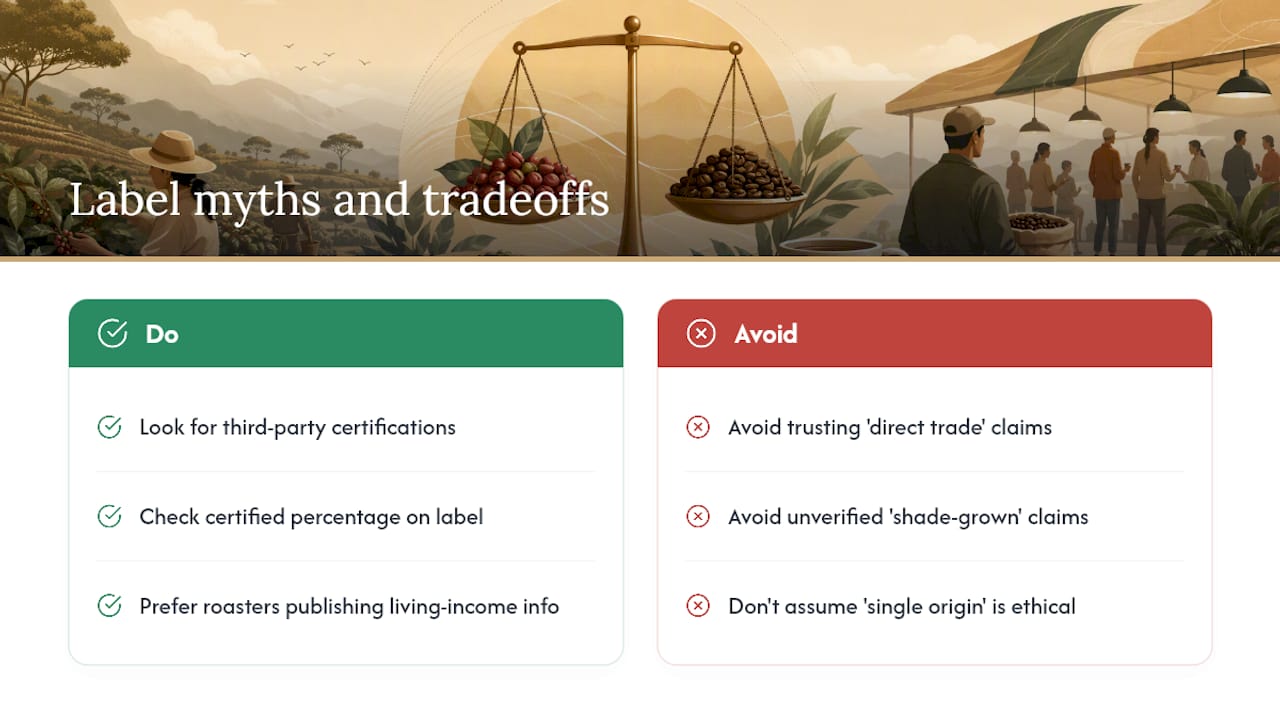
Common myths, misleading terms, and tradeoffs to watch for
Several terms appear on coffee packaging with no formal regulatory definition. Knowing which ones carry weight and which ones do not saves you from paying a premium for a story rather than a standard.
“Direct trade” is the most widely misused. There is no governing body, no audit requirement, and no agreed definition. One roaster’s “direct trade” means a single farm visit; another’s means a multi-year purchasing contract with documented price premiums. Without supporting evidence, the phrase means nothing verifiable.
“Single origin” describes geography, not ethics. A coffee from a single country or region can still come from a supply chain with no labor protections and no price guarantees. “Single farm” is more specific but still unaudited unless paired with a certification.
“Shade grown” without Bird-Friendly certification is a marketing claim. Shade conditions vary enormously, and there is no third-party standard attached to the phrase on its own.
“Consumers should look for third-party certifications rather than relying on marketing language, because terms like ‘direct trade’ are entirely unregulated and can mean almost anything.” — Modern Farmer, citing SCAA director Kim Elena Ionescu
Partial certification is a subtler trap. A package may legally display a Fairtrade or Rainforest Alliance logo even when only a portion of the blend is certified. U.S. labeling rules require disclosure of the certified percentage, but the logo can still dominate the visual design. Read the fine print.
Two genuine tradeoffs are worth acknowledging. Organic farming often increases labor demands, which can raise costs for smallholders without a corresponding price premium unless the organic certification itself commands one. And Fairtrade’s minimum price, while meaningful, does not automatically deliver a living income in high-cost-of-living origins. Buyers who care about living wages should look for roasters who explicitly publish above-minimum-price payments or living income commitments alongside their Fairtrade certification.
How Rowst sources ethically — applying the verification checklist
Rowst builds its sourcing model around direct relationships with small-scale producers, bypassing intermediaries to maintain both transparency and fair compensation at the farm level. That structure addresses the two most common failures in conventional supply chains: price opacity and traceability gaps.
Applied against the verification checklist from the previous section, here is what Rowst’s product pages demonstrate:
- Named origins and producers. Coffees like the El Salvador Pacamara are presented with specific origin details, variety information (Pacamara), and processing notes, giving buyers a starting point for independent research.
When you evaluate other roasters using this same standard, look for those same fields: farm or cooperative name, harvest date, processing method, and variety. A product page that offers all four is showing you real supply chain knowledge. One that offers only a country name and a flavor description is showing you a marketing exercise.
The Coffee Lover Pack from Rowst lets you sample multiple origins side by side, which is also a useful exercise in comparing how sourcing details are presented across different lots.
What buying ethically sourced coffee actually requires of us
There is a tendency in ethical consumption writing to treat certification as the finish line. It is not. Certifications are tools for accountability, and like any tool, their value depends on how they are used and whether the underlying system is functioning.
The most important shift a conscientious buyer can make is moving from passive label-reading to active verification. That means occasionally searching a roaster’s name in the Fairtrade or Rainforest Alliance public registry. It means asking a roaster directly what they pay above the minimum price. It means noticing when a company’s sourcing page is full of beautiful photography and empty of producer names.
Taste and ethics are not in tension. The coffees with the most traceable supply chains, grown by producers who are fairly compensated and farming with care for their land, tend to be among the most complex and rewarding in the cup. Terroir, after all, is not just geography. It is the accumulated result of how a place is tended and by whom.

The checklist in this guide is not meant to make buying coffee feel like homework. It is meant to make the ritual more meaningful. When you know the name of the cooperative, the harvest season, and the variety in your cup, the coffee tastes different. Not because the chemistry changed, but because the connection is real.
Rowst makes ethically sourced specialty coffee easy to find
Single-origin specialty coffee with genuine traceability should not require a research project. Rowst’s curated selection brings together coffees from Uganda, El Salvador, and Mexico, each sourced directly from small-scale producers with full origin transparency on every product page. No intermediaries, no vague origin stories, and no guessing about who grew your coffee.
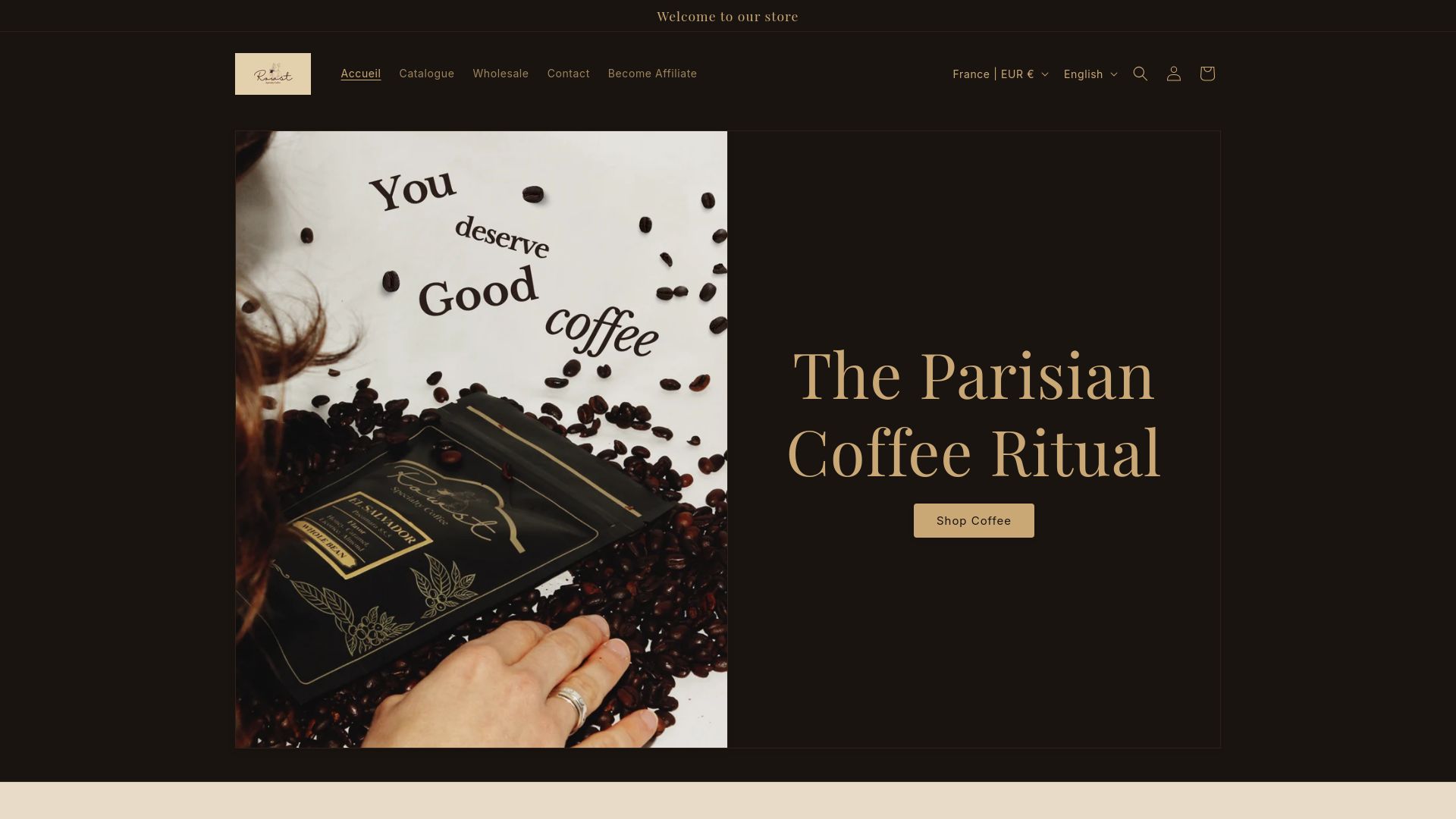
The Discovery Pack is the natural starting point: three distinct single-origin coffees that let you taste the difference traceability makes, with sourcing details presented the way this guide says they should be. Browse the full selection at Rowst and see what ethical sourcing looks like when it is built into every bag.
Sources
- The Rainforest Alliance assurance system: supporting due diligence across the supply chain
- CLEAR Supply Chains project brochure (ILO-led initiative addressing child labour in coffee supply chains)
- U.S. Department of Labor: List of Goods Produced by Child Labor or Forced Labor (entry: coffee)
- C.A.F.E. Practices Verification Organizations — SCS Global Services