

Agroforestry Coffee: The Evidence-Based Case for Shade
Agroforestry, coffee grown beneath a managed canopy of shade trees reliably strengthens climate resilience and builds carbon stocks when the design gets the details right. If you’re weighing this transition on your own farm or advising one that is, your first move costs nothing but a walk through the plot.
Before planting anything, assess:
- Slope and erosion risk across the parcel
- Existing shade cover and canopy gaps
- Recent disease history, especially coffee leaf rust and berry disease
- Water access and drainage patterns during peak rains
Key Takeaways
| Point | Details |
|---|---|
| Target shade density | Aim for 30–60% canopy cover; this band shows the strongest resilience and yield outcomes across studies. |
| Prioritize structure over species count | Multiple canopy layers and higher tree basal area predict carbon storage better than species diversity alone. |
| Pair soil work with shade | Combining mulching, compost, and reduced tillage with agroforestry can offset early yield concerns. |
| Watch dose dependent risks | Shade above roughly 60% raises humidity-linked disease risk and can suppress yields in some climates. |
| Choose direct-trade, shade-grown origins | Rowst sources single-origin lots like El Salvador Pacamara and Mexico Veracruz directly from producers managing these systems. |
Table of Contents
- What Is Agroforestry Coffee and Why Does the Evidence Support It?
- How Much Shade Does Coffee Actually Need?
- Managing Soil, Shade, and Pests Together
- When Does Shade Start Hurting Your Yield?
- What Stops Farmers From Adopting Agroforestry?
- How to Design and Roll Out an Agroforestry Coffee System
- Rowst’s View From the Sourcing Side
- Does Agroforestry Change How You Manage Water on a Coffee Farm?
- How Does Shade Affect Coffee Quality After Harvest?
- What Actually Moves the Needle in Agroforestry Coffee Design
- Bring the Story of Shade-Grown Coffee to Your Cup
- Sources
What Is Agroforestry Coffee and Why Does the Evidence Support It?
Agroforestry coffee pairs coffee shrubs with an intentionally structured layer of shade trees, native hardwoods, fruit trees, nitrogen fixers, or timber species, chosen for how they complement the crop rather than compete with it. This is the technical backbone of what most people mean by shade-grown coffee benefits, and it sits within the broader discipline of agroecology in coffee: designing farm systems that mimic natural forest structure while still producing a marketable crop.
The data backs the concept up with real numbers. A 2025 meta-analysis of 68 studies found that agroforestry reduced climate-related yield loss by roughly 31%, cut pest and disease incidence by about 24%, and lowered quality degradation by close to 19%, with the strongest outcomes clustering in the 30–60% shade band.
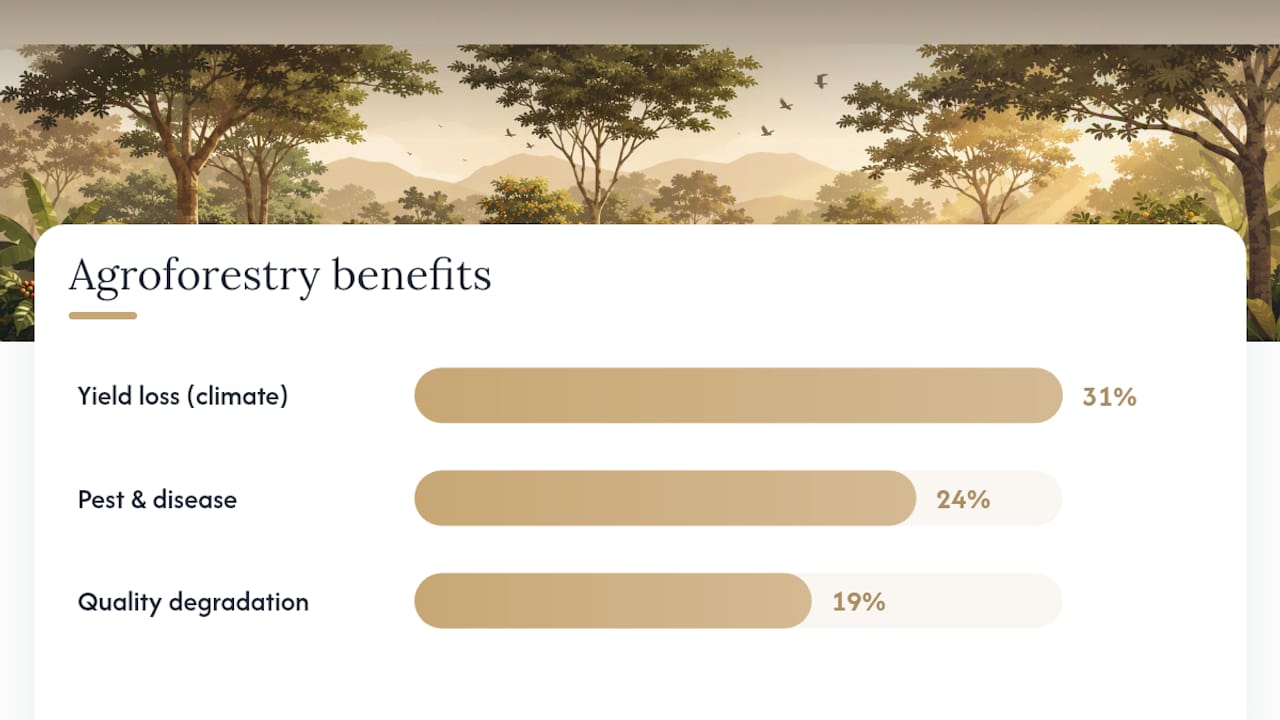
Statistic Callout: Coffee grown under 30–60% shade cover shows measurably better resilience across climate, pest, and quality metrics than both full-sun and heavily shaded systems, according to pooled results from numerous studies.
Carbon findings tell a parallel story. A systematic review of 46 studies found that soil organic carbon is usually the largest carbon pool in these systems and that tree size and basal area predict total carbon storage more reliably than simply counting how many species are planted. Evidence is strongest in Latin America and East Africa, where long-running trial networks exist; data from parts of Southeast Asia remains thinner.
- Yield stability improves most in mid-elevation, moderate-rainfall zones
- Carbon gains scale with tree basal area, not species count alone
- Disease suppression depends heavily on canopy airflow, not just shade percentage
How Much Shade Does Coffee Actually Need?
The 30–60% shade range is recognized as the balance point where microclimate buffering, tree competition, and disease pressure optimize coffee growth conditions. Below 30%, coffee loses the temperature buffering that shade provides; above 60%, humidity climbs, air movement drops, and fungal pathogens gain ground.
Structural complexity matters more than raw species diversity. A farm with three well-chosen tree species arranged across two or three canopy layers, a low fruit-tree layer, a mid-story of nitrogen fixers, and scattered emergent hardwoods, often outperforms a monoculture shade canopy planted with a dozen species crammed into one height class.
Prioritize trees with these traits:
- Deep taproots that don’t compete with coffee’s shallow feeder roots
- Phenology that doesn’t overlap coffee’s flowering and fruiting windows
- A marketable secondary output: timber, fruit, or fuelwood
- Nitrogen-fixing capacity (Inga and Erythrina species are common choices in Latin America)
Pro Tip: Before planting, sketch your canopy in cross-section, not just from above. A map of species locations tells you nothing about whether you’ve actually built three functional light layers instead of one crowded one.
Managing Soil, Shade, and Pests Together
Healthy agroforestry coffee performs best when soil, shade, and pest management are handled as one system, not three separate chores.
- Build soil organically. Mulch pruning residue back onto beds, apply compost seasonally, and grow low-growing cover crops between rows to suppress weeds and add organic matter. Minimize tillage, which disrupts the fungal networks that shade trees help sustain.
- Prune on a schedule, not a whim. Thin shade canopy at the start of the dry season to let more light through during flowering, then let canopy density build again before the heaviest rains to buffer humidity swings.
- Intercrop with intention. Banana, plantain, and short-cycle legumes planted in early years generate income while young shade trees establish, a common practice in permaculture coffee systems designed for staged returns.
- Layer in integrated pest management. Shade-grown systems tend to host more natural pest predators, but scout regularly for coffee berry borer in denser sections where humidity runs higher.
Pro Tip: Kenyan field trials pairing no-till, mulching, composting, and indigenous microorganisms with shade management increased yield by 1.12 kilograms per tree and sharply cut disease incidence within the first seasons, evidence that agroforestry doesn’t have to mean sacrificing near-term production.
When Does Shade Start Hurting Your Yield?
Shade’s relationship to yield isn’t a straight line. It’s a curve, and knowing where you sit on it matters more than any single rule of thumb. Moderate shade optimizes resilience and keeps production steady. Push past roughly 60% canopy cover, though, and the same humidity that suppresses some diseases starts feeding others, while reduced light can slow bean fill and lower per-plant output.
Statistic Callout: The 2025 meta-analysis found the protective effects of shade held consistently across geographies within the 30–60% band, but diminished sharply once canopy density moved beyond it.
Where your farm sits on that curve depends on local conditions:
- Elevation: higher-altitude farms tolerate less shade before humidity issues appear
- Rainfall: wetter regions need more airflow management to avoid dense-shade disease spikes
- Cultivar: disease-resistant varieties buy you more flexibility at the higher end of the shade range
- Disease history: farms with recurring rust or berry disease should stay conservative on canopy density
Mitigation is usually simpler than a full redesign: selective thinning of overcrowded canopy, switching to drought-tolerant cultivars where water stress is the bigger risk, and targeted pruning timed to flowering rather than a fixed calendar date.
What Stops Farmers From Adopting Agroforestry?
The barriers are practical, not philosophical. Transitioning to agroforestry coffee usually means more labor, selective harvesting and multiple pick rounds instead of one strip-pick, plus the upfront cost of seedlings, nursery time, and years of reduced income while trees establish. For smallholders without savings or credit access, that gap is often the real obstacle, not a lack of interest in sustainable coffee farming.
Support mechanisms exist and they work when they’re structured well:
- Cooperative membership that pools resources for seedlings and shared equipment
- Certification premiums that reward verified shade or organic practices
- Payments for ecosystem services (PES) tied to carbon or biodiversity outcomes
- Direct-trade partnerships that pay above commodity price for verified quality and origin
The equity risk is real: premiums only help if they reach the farmer, not just the exporter. Buyer relationships built on transparency, not just a certification label, tend to hold up better over multiple harvest cycles.
How to Design and Roll Out an Agroforestry Coffee System
Sequencing matters. Rushing shade tree planting before assessing your baseline conditions is the most common design mistake advisers see.
- Assess the site. Slope, existing canopy, soil type, water access, and disease history, the same checklist from the opening of this guide, done formally with measurements this time.
- Select species and plan the nursery. Match tree traits (root depth, phenology, marketable output) to your climate and market access; stagger planting so shade builds gradually rather than all at once.
- Plant with spacing discipline. Leave enough room for canopy layers to mature without immediately shading coffee at damaging density.
- Manage years one through three. Focus on establishment: irrigation support for young trees, weed suppression, and light pruning as canopy fills in.
- Monitor years three through ten. Track the indicators below annually.
| Indicator | What to measure |
|---|---|
| Shade percentage | Canopy cover estimated via densiometer or photo analysis, target 30–60% |
| Soil organic carbon proxy | Soil color, texture, and earthworm activity as low-cost field indicators |
| Yield per tree | Kilograms of cherry per coffee plant, tracked against pre-transition baseline |
| Disease incidence | Percentage of plants showing rust or berry disease symptoms per scouting round |
Rowst’s View From the Sourcing Side
Rowst builds direct relationships with small-scale producers rather than buying through intermediaries, which means seeing agroforestry conditions firsthand across origins like El Salvador, Uganda, and Mexico. That vantage point shapes how we think about this topic.
- Direct-trade sourcing rewards quality and traceability, which strengthens the financial case for farmers investing in shade systems
- Producers Rowst works with, growing lots like Pacamara in El Salvador and Bugisu in Uganda, operate in classic shade-grown terroir
- Better farmer compensation reduces the adoption barrier that upfront agroforestry costs create
- Traceability lets buyers verify shade and sustainable coffee farming claims instead of taking a label at face value
Does Agroforestry Change How You Manage Water on a Coffee Farm?
Shade canopy and water management aren’t separate systems. They’re the same system viewed from different angles. Tree cover slows evaporation from soil, moderates temperature swings that drive water stress, and improves infiltration by keeping soil structure intact through root networks and leaf litter. Farms with well-designed coffee agroecosystems typically hold soil moisture longer into dry spells than exposed monoculture plots.
That buffering matters most where rainfall is becoming less predictable. Deep-rooted shade species pull water from lower soil horizons, effectively tapping a reserve that shallow-rooted coffee plants can’t reach on their own. This doesn’t eliminate the need for deliberate water infrastructure, but it changes what that infrastructure needs to do.
Practical integration points include:
- Contour planting of shade trees on slopes to slow runoff and reduce erosion during heavy rain
- Mulch layers from pruned shade tree material, which cut surface evaporation significantly compared to bare soil
- Strategic gaps in canopy near water catchment points to avoid excessive interception of rainfall meant for storage
- Cover crops between coffee rows to improve infiltration rates during intense rain events
Regions with pronounced dry seasons, parts of Central America and East Africa among them, benefit most from pairing agroforestry design with small-scale water harvesting: swales, infiltration pits, or simple check dams positioned to catch runoff before it leaves the plot. The shade canopy does the slow, steady work of moisture retention; the water infrastructure handles the acute stress of drought months. Neither substitutes for the other, and farms that treat them as one integrated design tend to show the strongest resilience during erratic rainfall years.
How Does Shade Affect Coffee Quality After Harvest?
Shade-grown coffee often develops differently at the cherry level before it ever reaches a drying patio, and that difference carries through processing. Slower cherry maturation under moderate shade tends to allow more even sugar development, which processors and roasters frequently associate with more balanced acidity and fuller body in the cup. That’s part of why shade-grown lots often command attention in specialty markets, quality that starts in the canopy shows up in the final product.
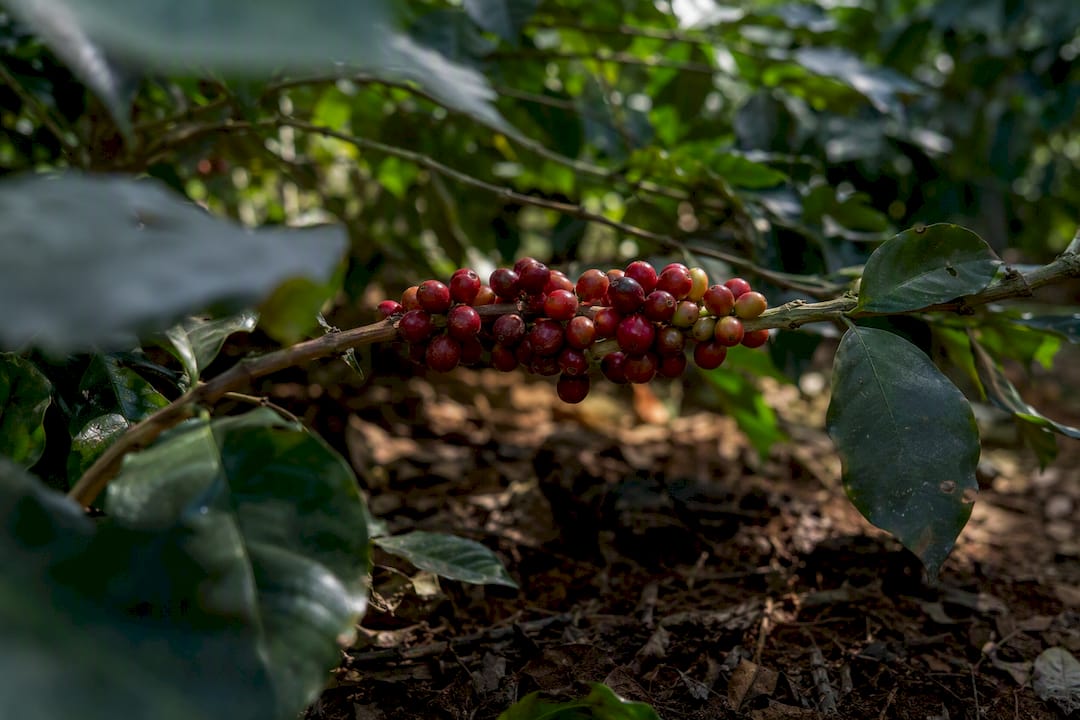
Post-harvest handling still determines whether that potential gets realized. Shade-grown cherry, harvested in more selective, multiple-pass rounds due to uneven ripening under canopy, requires processors to sort more carefully by ripeness before pulping. Farms that skip this step lose much of the quality advantage shade provided in the field.
Drying also behaves differently. Farms in humid, heavily shaded microclimates need better airflow on drying beds or patios to avoid mold risk, since the same humidity buffering that helps the living plant can slow moisture loss from parchment coffee post-harvest.
For market positioning, verified shade-grown origin increasingly functions as a quality signal, not just an environmental one. Buyers willing to pay for traceable, agroforestry-grown lots are often paying for both the story and a genuinely different cup profile, one shaped by slower ripening and the biodiversity of a working coffee agroecosystem.
What Actually Moves the Needle in Agroforestry Coffee Design
Most agroforestry advice stops at “plant shade trees” and calls it done. That’s the gap between what gets repeated and what the research actually supports. The real lever isn’t shade presence, it’s shade architecture: canopy layering, tree basal area, and species traits chosen for non-competition rather than convenience.
Conventional advice also tends to treat yield loss as an inevitable cost of going sustainable. The Kenyan field trials pairing soil restoration with shade management complicate that story, showing near-term yield gains are achievable when soil work and canopy design happen together, not sequentially.
If you’re prioritizing one thing first, make it the site assessment, not the tree order. Farms that skip diagnosing their slope, existing canopy, and disease history end up retrofitting expensive mistakes years later. Get the shade percentage and structural layering right from the start, and the carbon storage, pest suppression, and quality gains tend to follow as a consequence of good design, not a separate initiative bolted on top.
— Diego
Bring the Story of Shade-Grown Coffee to Your Cup
Every bag Rowst sells traces back to a farm, not a commodity exchange, which means the shade-grown, agroforestry-conscious origins in this guide aren’t abstractions to us. They’re the producers we buy directly from. Rowst’s model cuts out intermediaries so more of what you pay reaches the people managing that canopy, pruning schedule, and soil health year after year.

If the case for agroforestry coffee resonated with you, taste it directly. The El Salvador Pacamara comes from shade-grown terroir with the structural complexity this guide describes, and the Mexico Veracruz offers a different altitude and canopy profile worth comparing side by side. Not sure where to start? The Coffee Lover Pack bundles several origins so you can taste the difference shade and terroir actually make. Order a bag and see what direct-sourced, shade-grown coffee tastes like when the relationship behind it is real.
Sources
These are the primary studies and guidance documents behind the claims in this article, useful for readers who want to verify the numbers or go deeper into the methodology.
- Mitigating climate risks in coffee production through agroforestry: global evidence (Frontiers, 2025)
- Agroforestry and carbon in coffee systems (MDPI systematic review)