

What Coffee Bloom Is and Why It Changes Your Cup
A coffee bloom is the bubbling you see when hot water first hits freshly ground coffee. It’s carbon dioxide escaping, and letting it happen before the main pour lets water reach the grounds evenly for a fuller, less sour cup. That’s coffee bloom explained in one breath, and it’s the single easiest technique upgrade available to anyone making pour-over at home.
Here’s what matters for your next brew:
- What you’ll see: foam and bubbles rising within seconds of the first pour
- Why it happens: trapped CO2 from roasting is releasing rapidly
- The rule of thumb: use about 2 times the coffee’s weight in water, and wait 30 to 45 seconds before continuing your pour
Key Takeaways
Coffee bloom works because trapped CO2 needs time to escape before water can saturate grounds evenly, and skipping that step directly causes sour, uneven extraction.
| Point | Details |
|---|---|
| Bloom is CO2 escaping | Roasting traps gas inside beans, and grinding plus hot water releases it rapidly. |
| Use the 2x water rule | Bloom with roughly double the coffee weight in water for 30 to 45 seconds. |
| Pour-over needs it most | A single water pass means uneven saturation from skipped bloom shows up directly in flavor. |
| Bubbles are a freshness signal | Vigorous bloom means fresh coffee; weak bloom often means aged or poorly stored beans. |
| Roast date drives results | Rowst labels roast dates and uses one-way valve packaging so you can time your brew and compare bloom across origins. |
Table of Contents
- What Causes Coffee Bloom in the First Place?
- Why Does Coffee Bloom Actually Change the Flavor?
- How Do You Bloom Coffee Step by Step?
- When Does Bloom Matter Most, and When Can You Skip It?
- What Does Your Coffee’s Bubbling Actually Tell You?
- Why Isn’t My Coffee Blooming?
- How Rowst Approaches Roast Date and Storage for Better Bloom
- A Note From Diego on Getting Curious About Your Bloom
- Try a Discovery Pack to See Bloom for Yourself
- Frequently Asked Questions
- Sources
What Causes Coffee Bloom in the First Place?
Bloom starts at the roaster, not at your kettle. During roasting, beans undergo chemical reactions that produce carbon dioxide, and that gas gets trapped inside the bean’s porous cell structure. A freshly roasted bean is essentially a tiny pressurized vessel, holding onto gas it has no way to release until something breaks the seal.
Grinding is that something. It shatters the cell walls and multiplies the bean’s surface area, which gives trapped CO2 a fast exit route. This is why whole beans barely bloom when wetted, while ground coffee erupts almost instantly. The finer the grind, the more surface area you expose, and the faster the gas escapes
Here’s the mechanism in short form:
- Roasting creates CO2 and locks it inside the bean’s cell structure
- Grinding breaks that structure open and exposes far more surface area
- Hot water triggers a rapid release, which you see as foam and bubbling
- The bubbles are gas escaping through water, not water reacting with coffee oils
Degassing timelines matter more than most home brewers realize. The Specialty Coffee Association notes that CO2 release is most rapid in the days immediately after roasting, then slows sharply as the bean ages. A bag roasted two days ago behaves completely differently in the kettle than one roasted three weeks ago, even if both smell fresh out of the bag.
Pro Tip: If your bloom looks anemic, check the roast date before blaming your technique. Coffee past the three or four week mark has usually released most of its CO2 already, so a flat bloom might just mean an old bag, not a bad pour.
Why Does Coffee Bloom Actually Change the Flavor?
CO2 is not a passive bystander during brewing. It actively repels water. As gas pushes outward from the grounds, it creates pockets where water simply cannot make contact, and that leads to uneven saturation. Roastopedia explains that this escaping gas physically blocks water from reaching parts of the coffee bed, which sets up channeling: water finds the path of least resistance, rushes through it, and leaves other grounds barely touched.
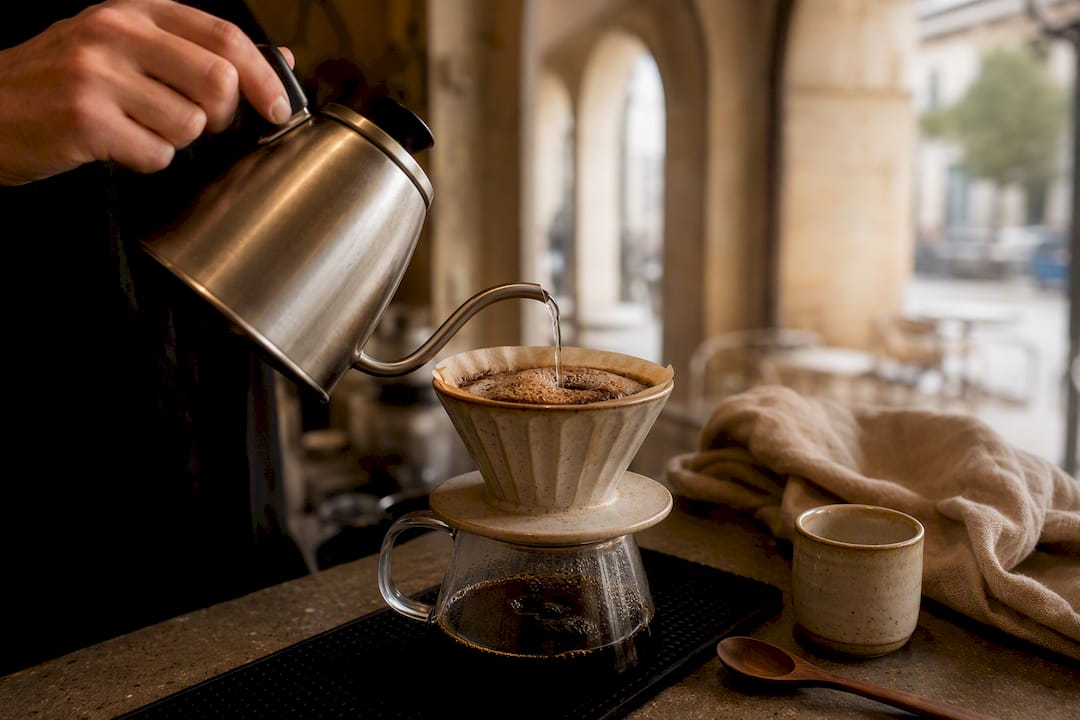
The result is a cup that’s simultaneously over-extracted in some spots and under-extracted in others. You taste that as a strange mix of sourness and thinness, even though your recipe and grind size were technically correct.
This isn’t just theory. Blind tasting comparisons run by Serious Eats found that bloomed pour-over generally tasted fuller and rounder, while skipped-bloom samples came across flatter and occasionally more acidic. Letting the gas escape before the main pour gives water a clean, even path through the grounds instead of a battle against rising CO2.
The coffee that skipped its bloom tasted noticeably sharper and less developed. That gap between bloomed and un-bloomed samples showed up consistently across repeated tastings, not just once.
Skipping bloom entirely doesn’t ruin a cup, but it stacks the odds against you. Fresh coffee has plenty of CO2 left to fight, and without a bloom step, that fight happens during your primary extraction instead of before it. Sour, sharp, or thin results after an otherwise careful pour often trace straight back to this.
How Do You Bloom Coffee Step by Step?
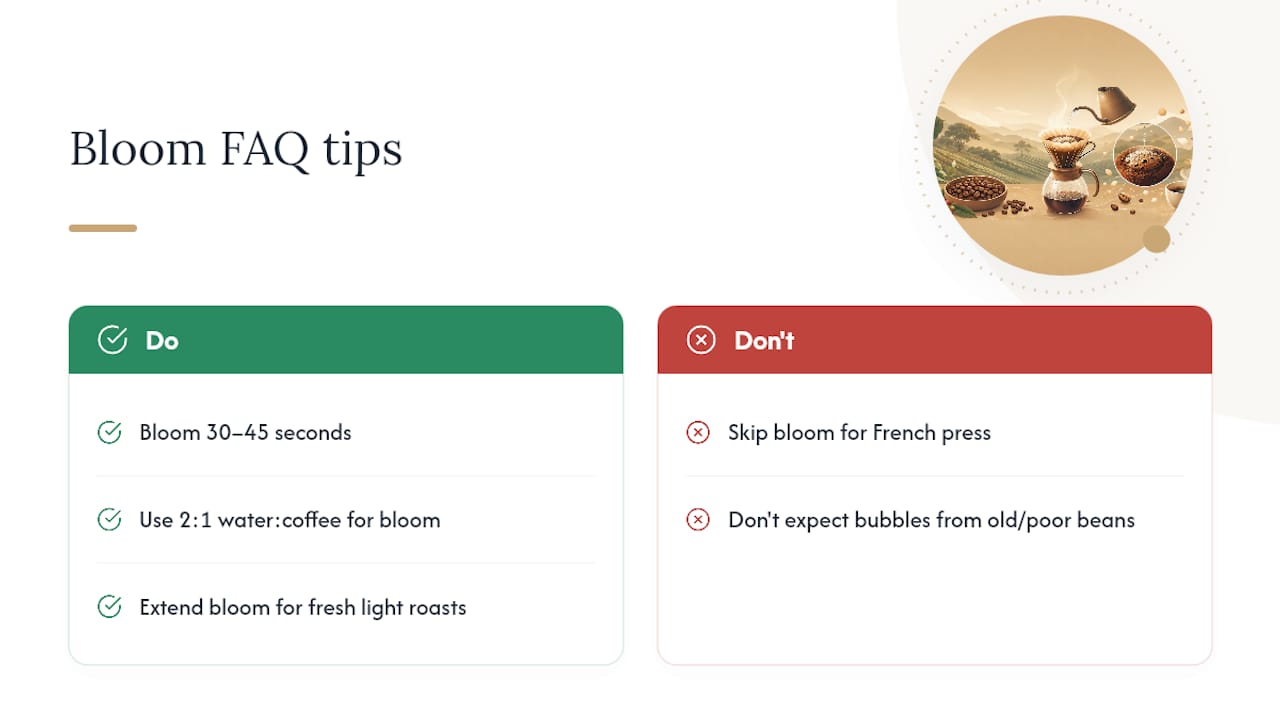
The general bloom rule stays consistent across methods: use roughly twice the coffee’s weight in water, and give it 30 to 45 seconds before you move on. From there, the method changes the details.
For pour-over:
- Grind your coffee to a medium consistency, right around the texture of coarse sand.
- Weigh out your dose (say, 20 grams of coffee for a standard mug).
- Pour about 40 grams of hot water, just enough to fully saturate the grounds without pooling underneath.
- Wait 30 to 45 seconds and watch the bed rise and bubble.
- Continue your normal pour once the bubbling settles and the bed starts to sink slightly.
For French press and other immersion methods:
A dedicated bloom step is optional here. Because grounds sit in contact with water for several minutes, degassing happens naturally during the steep. Some brewers still pre-wet and stir at the start to knock loose surface gas and prevent a thick foam cap, but immersion brewing degasses on its own timeline simply because the contact time is longer.
For espresso:
Bloom in the pour-over sense doesn’t apply, but roast date and rest time do the same job. Espresso pulled from beans roasted within a day or two often chokes the shot with excess gas, causing channeling and inconsistent crema. Most baristas rest beans for several days to a week after roasting before dialing in a shot, letting early, aggressive degassing settle down first.
Pro Tip: Watch the bed, not the clock. If your bloom is still actively bubbling at the 45 second mark, give it another 10 to 15 seconds. A settled, slightly domed bed is a better cue than a rigid timer.
When Does Bloom Matter Most, and When Can You Skip It?
Bloom pulls the most weight in pour-over. Because water passes through the grounds just once on its way to your cup, any uneven saturation from trapped CO2 shows up directly in the final flavor. There’s no second chance for water to correct course the way there is in a longer steep.
Immersion methods are far more forgiving. French press coffee steeps for minutes, giving gas plenty of time to escape gradually, which is why a dedicated bloom step is often skipped without much flavor penalty.
A few situations worth knowing:
- Very fresh, light roast coffee: blooms harder and longer since lighter roasts tend to retain CO2 longer than darker ones, so give it extra time
- Extended or “long” blooms: some brewers experiment with bloom times stretching several minutes, and tests have shown this can push extraction higher, often trading some brightness for added sweetness and body
- Dark roasts: degas faster and bloom less dramatically, so don’t expect the same fireworks
The trade-off with longer blooms is real: more extraction isn’t automatically better, and pushing bloom time too far can pull out bitterness along with the sweetness you were chasing.
What Does Your Coffee’s Bubbling Actually Tell You?
The bubbles themselves are a diagnostic tool, not just a visual show. A vigorous, rising, foamy bloom almost always signals fresh coffee with plenty of CO2 left to release. A weak, quiet bloom points to older or improperly stored beans that have already lost most of their gas.
Some quick reads worth remembering:
- Bubbling after the main pour starts: the initial bloom didn’t fully wet or release gas, so extend your bloom time next round
- A bag that puffs up on the shelf: a sign of active degassing and reasonably fresh roast
- Coffee that’s been frozen: freezing slows degassing considerably, which is why some enthusiasts freeze portions to preserve bloom potential for later brewing
None of these signs demand a lab. Your eyes and a kitchen timer are enough to read what’s happening in the cup.
Why Isn’t My Coffee Blooming?
A flat or missing bloom almost always traces back to one of three culprits, and each has a specific fix.
- Check the roast date first. Coffee brewed a month or more after roasting has released most of its CO2 already, so a weak bloom is often a freshness issue rather than a technique problem. Fresher beans, ground right before brewing, restore a proper bloom.
- Look at storage. Beans left in a paper bag on the counter degas faster and lose aroma sooner than those kept in an airtight, cool container.
- If bloom is excessive or channeling badly, try a slightly coarser grind or extend your rest time by a day or two before brewing again.
Dark and oily roasts behave differently by nature. Expect a quicker, less dramatic bloom and some surface oil, and don’t read that as a flaw, just a different roast profile doing what it does.
How Rowst Approaches Roast Date and Storage for Better Bloom
Bloom behavior starts long before your kettle boils, which is why Rowst prints the roast date on every bag rather than a vague “best by” window — a practice also found in carefully sourced artisanal teas that ensures freshness and quality from origin to cup. Knowing exactly how many days out you’re brewing tells you what kind of bloom to expect.
- Roast date labeling lets you time your brew instead of guessing
- One-way valve packaging lets CO2 escape gradually without letting oxygen in, which keeps beans fresher longer before you even open the bag
- Store beans airtight, cool, and away from light, and buy in single-bag servings you’ll actually finish in a few weeks
- A Discovery Pack is a practical way to compare bloom intensity across different origins side by side
A Note From Diego on Getting Curious About Your Bloom
Log the roast date and bloom time for every bag you brew. It sounds fussy, but the pattern becomes obvious after a few bags, and you’ll start predicting bloom behavior before the water even hits the grounds.
Run a blind taste test if you’re skeptical. Brew one cup with a proper bloom and one without, using the same beans, and taste them side by side without knowing which is which. Most people notice the difference immediately.
None of this replaces your own palate. The “right” bloom time is whatever produces the cup you actually want to drink.
Try a Discovery Pack to See Bloom for Yourself
Reading about bloom only gets you so far. Rowst gives you a direct way to test it, since every bag ships with a printed roast date and one-way valve packaging that protects the CO2 timing your bloom depends on. Sourcing beans directly from small-scale producers in places like Uganda, El Salvador, and Mexico also means you’re comparing origins with genuinely different bloom personalities, not just different labels on the same base coffee.
The Discovery Pack is built exactly for this kind of comparison, letting you brew several origins side by side and watch how bloom intensity shifts with roast date and bean origin. If you’d rather commit to one profile at a time, the Coffee Lover Pack rotates through single-origin selections so you can track bloom behavior bag after bag. Pick one, note the roast date when it arrives, and brew your next pour-over with a stopwatch running.
Frequently Asked Questions
How long should you let coffee bloom? Most recipes call for 30 to 45 seconds, though very fresh light roasts sometimes benefit from a few extra seconds since they hold onto CO2 longer.
What’s the ideal ratio of water to coffee for blooming? A common starting point is twice the coffee’s weight in water, so 20 grams of coffee gets about 40 grams of water for the bloom itself.
Does French press need a bloom step? Not really. Immersion brewing gives gas several minutes to escape naturally during the steep, so a dedicated bloom is optional rather than essential.
Why isn’t my coffee blooming at all? It’s almost always roast date or storage. Beans brewed weeks after roasting, or stored in a leaky bag, have already released most of their CO2 and won’t bubble much.
Does roast level affect how coffee blooms? Yes. Lighter roasts tend to hold onto CO2 longer than darker roasts, so they often bloom more dramatically and may need slightly longer rest before brewing.
Sources
For deeper reading on the science and testing behind this guide, the Specialty Coffee Association’s breakdown of coffee freshness covers degassing timelines in detail. Serious Eats has run practical bloom tests and taste comparisons, and Roastopedia offers a clear primer on why degassing affects extraction.
- Coffee bloom explained: what it is, why it happens, and how to do it right — Serious Eats
- Coffee decoded: What is “freshly roasted” coffee? — Specialty Coffee Association
- Why does coffee require degassing before brewing? — Roastopedia