

How to Freeze Coffee Beans and Keep Them Fresh
Yes, you should freeze whole coffee beans — but only under the right conditions. If you have a specialty single-origin bag you won’t finish within two to three weeks, sealing it airtight and placing it in the freezer is one of the most effective ways to preserve its aromatic complexity. The key conditions: high-quality beans worth protecting, truly airtight packaging, portioned into single-use amounts, and a firm commitment to never thawing and refreezing. Coffee experts consistently agree that freezing is the right call for beans you won’t use for several weeks or months — not for the bag you open every morning.
When freezing makes sense: you’ve just bought a beautiful Uganda Bugisu or an El Salvador Pacamara, and you know you won’t reach the bottom of the bag for a month. Freeze it. When it doesn’t: your daily grind bag is half-empty and you pull from it every morning. Leave it on the counter in an airtight canister and enjoy it fresh.
Key Takeaways
Freezing whole coffee beans preserves aromatic quality for months when you seal them airtight, portion them before freezing, and never refreeze a thawed batch.
| Point | Details |
|---|---|
| When to freeze | Freeze specialty beans you won’t use within 2–3 weeks; skip freezing for daily-use bags. |
| Three sealing rules | Airtight packaging, single-use portions (25–40 g), and a labeled freeze date on every packet. |
| Thawing and grinding | Grind from frozen for best consistency, or let the sealed packet warm fully before opening to avoid condensation. |
| Never refreeze | One freeze-thaw cycle per portion; repeated cycling introduces moisture and accelerates staling. |
| Rowst beans | Rowst single-origin coffees are ideal candidates for freezing, available as individual origins or in the Coffee Lover Pack. |
Table of Contents
- How to freeze coffee beans at home: a step-by-step method
- What packaging actually protects your beans
- How long can you keep beans frozen?
- Should you grind frozen beans or thaw them first?
- Freezer vs refrigerator vs room temperature: which is right for you?
- Common mistakes that strip flavor from frozen beans
- Quick answers: the 15-15-15 rule, ground coffee, and valve taping
- Why freezing works: the science behind the method
- My honest take on freezing for home brewers
- Rowst’s single-origin beans are worth freezing
- Sources
How to freeze coffee beans at home: a step-by-step method
This sequence takes about ten minutes and sets you up for months of preserved flavor.
- Freeze soon after purchase. The ideal window is within the first week or two of the roast date, while the beans are still at or near peak freshness. Freezing already-stale beans locks in staleness, not quality.
- Divide into single-use portions. Portioning before freezing is the single most important step most home brewers skip. Aim for 25–40 g per packet — roughly one to two brews — so you never open a bag just to pull a small amount and expose the rest to air.
- Choose your sealing method. Vacuum sealing is the gold standard: it removes oxygen and creates a tight barrier against freezer odors. A heavy-duty zip-top bag with as much air pressed out as possible works as a practical backup. If you’re freezing an unopened roaster bag, tape over the one-way degassing valve before it goes in.
- Place in the coldest part of your freezer. The back of the bottom shelf, away from the door, stays at the most stable temperature. Avoid spots near the door where temperature fluctuates every time you reach for something else.
- Retrieve one portion at a time — and never refreeze. Once a portion comes out, it stays out. Repeated freeze-thaw cycles promote moisture and accelerate staling faster than room-temperature storage would.
Pro Tip: Label every packet with the freeze date, roast date if you know it, and the coffee’s name. Future you will be grateful when you’re staring at three identical white packets in January.
What packaging actually protects your beans
Oxygen and freezer odors are the two enemies inside your freezer. Airtight packaging addresses both, but not all containers perform equally. Home containers often allow small amounts of oxygen through over time, which is why the choice of vessel matters more than most people expect, especially in humid climates where room-temperature storage already accelerates staling.
Practical options, ranked by effectiveness:
- Vacuum-sealed bags or pouches: The best choice. A handheld vacuum sealer like a FoodSaver removes nearly all oxygen before the bag is sealed. Single-dose pouches (25–40 g) are the format specialty baristas use for competition prep.
- Roaster bag with valve taped: If the bag arrived sealed from the roastery, tape over the one-way valve with electrical tape or masking tape, then place the whole bag inside a zip-top freezer bag for an extra odor barrier.
- Heavy-duty zip-top freezer bags: Press out as much air as possible before sealing. Double-bag if your freezer has strong odors from other foods. Not as reliable as vacuum sealing, but far better than a thin bag or a loosely closed canister.
- Rigid airtight canisters: Useful for organizing single-dose packets inside the freezer, but not a primary seal on their own — pair them with a vacuum-sealed inner bag.
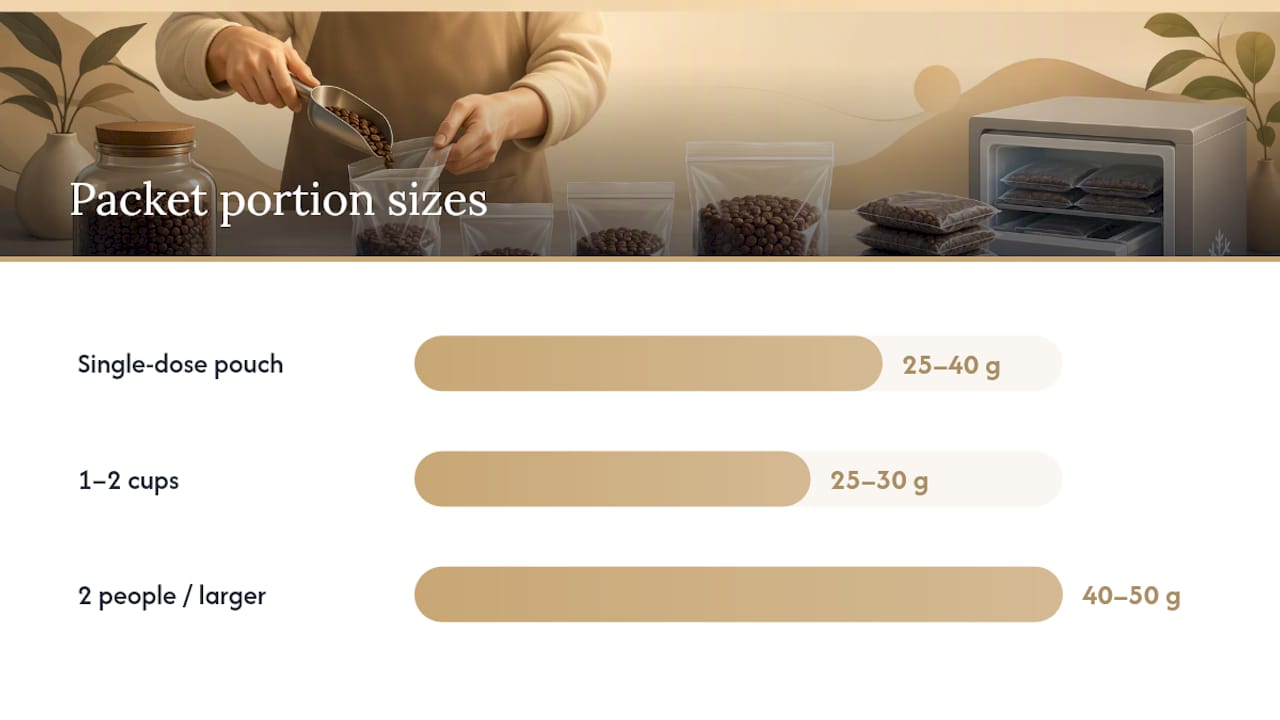
Portion size depends on your brewing rhythm. If you brew one or two cups daily, 25–30 g packets match a single session. If you brew for two people or use a larger brewer, 40–50 g packets make more sense. The goal is to open one packet, use it entirely, and never put any back.
Pro Tip: Write the roast date on the label, not just the freeze date. Knowing both tells you exactly where the beans are in their flavor arc when you pull them out.
How long can you keep beans frozen?
Freezing slows the clock on staling, but it does not stop it entirely. Volatile aromatic compounds continue to escape, just far more slowly at low temperatures. Here’s how to think about storage windows:
Freezing at around -25°C (-13°F) with vacuum sealing significantly reduces both oxidation and degassing, which is why many specialty roasters and baristas confidently hold beans for up to six months under those conditions. A standard home freezer runs around -18°C (0°F), which is effective but slightly less aggressive. Under those conditions, three to four months is a reliable quality window for most home setups.
Label every packet with:
- Freeze date
- Roast date (if printed on the bag)
- Coffee name and origin
- Portion weight
Should you grind frozen beans or thaw them first?
Both approaches work. The choice comes down to your setup and how much you care about grind consistency.
- Grind straight from frozen: Frozen beans are more brittle, which tends to produce a more uniform particle distribution and fewer fines. Practitioners consistently report cleaner extraction and better cup clarity when grinding directly from the freezer. This is the preferred method if your grinder can handle it.
- Thaw before grinding: Take the sealed packet out of the freezer and let it reach room temperature before opening it. This typically takes 30–45 minutes for a small portion. The critical rule: do not open the bag while it’s still cold. Opening a cold package invites moist air, and condensation forms on the beans almost instantly, accelerating staling.
A few practical notes for brewing after freezing:
- Frozen beans may require a slightly finer grind setting than the same coffee stored at room temperature. Dial in with a small test shot before committing to a full brew.
- If you’re switching a familiar coffee from fresh to frozen, expect a brief adjustment period. The flavor profile is preserved, but the extraction behavior can shift slightly.
- Never rinse or wipe beans after thawing. Any added moisture is the opposite of what you want.
Pro Tip: If you grind from frozen, give your grinder a moment to clear between doses. Cold beans can cause a small amount of static buildup in some grinders, which affects retention.
Freezer vs refrigerator vs room temperature: which is right for you?
The right storage method depends entirely on how quickly you go through your beans.
Room temperature is the right choice for daily-use coffee you’ll finish within one to three weeks. An opaque, airtight canister away from heat and light is all you need. This is how most specialty cafés store their working stock.
The refrigerator is almost always the wrong choice. It runs at temperatures that don’t slow staling enough to matter, while introducing two serious risks: humidity and odor absorption. Coffee is remarkably porous and will pick up the smell of last night’s leftovers. Unless you have a dedicated, sealed coffee drawer with no other food, skip the fridge entirely.
The freezer earns its place when you have beans you won’t touch for several weeks or longer, and you can seal them properly. Specialty roasters and baristas rely on freezing with vacuum sealing and portioning to preserve rare and competition-grade coffees for months without meaningful quality loss.
A quick decision guide:
- Finishing the bag within 1–3 weeks? Airtight canister at room temperature.
- Won’t use it for 3 weeks to 6 months? Vacuum-seal, portion, and freeze.
- Considering the fridge? Don’t.
Common mistakes that strip flavor from frozen beans
Most freezing failures come down to a handful of avoidable errors.
- Refreezing after thawing. Once a portion is out, it’s out. Each freeze-thaw cycle introduces moisture and accelerates staling. Portioning before freezing is the fix.
- Using thin or low-quality bags. A standard sandwich bag or a loosely sealed container lets freezer odors in and moisture through. Heavy-duty freezer bags or vacuum pouches are non-negotiable.
- Forgetting to tape the one-way valve. Roaster bags have a small degassing valve that lets CO₂ out but also lets air in when the pressure equalizes. Tape it shut before the bag goes in the freezer.
- Opening cold packages. This is where most people lose flavor without realizing it. Humid room air hits the cold beans and condenses immediately. Always let the sealed packet warm to room temperature before opening.
- No labeling. Unlabeled packets lead to guessing, which leads to using beans that have been frozen for eight months without knowing it.
The pattern behind every mistake is the same: a shortcut that introduces air, moisture, or temperature instability. The method works when you protect the beans from all three.
Quick answers: the 15-15-15 rule, ground coffee, and valve taping
What is the 15-15-15 rule? The 15-15-15 rule is a guideline sometimes cited in specialty coffee circles: let frozen beans rest for 15 minutes after removing from the freezer, grind within 15 minutes of opening the package, and brew within 15 minutes of grinding. It’s a useful framework for maintaining consistency, though the most important element is simply not opening the package while it’s still cold.
Can you freeze ground coffee? Generally, avoid it. Ground coffee has a dramatically larger surface area, which means it loses volatile compounds and absorbs moisture much faster than whole beans. If you must freeze ground coffee, vacuum-seal it in single-dose packets and use it within a few weeks. Whole beans retain essential oils and aromatic compounds far better until the moment of grinding.
Should you tape the one-way valve on a roaster bag? Yes, always, before freezing. The valve is designed to release CO₂ during degassing at room temperature. In the freezer, it becomes a potential entry point for air and odors. A strip of electrical tape or masking tape over the valve takes five seconds and meaningfully reduces the risk.
Why freezing works: the science behind the method
The chemistry of coffee staling is driven by oxidation and the escape of volatile aromatic compounds. Both processes are temperature-dependent: lower temperatures slow the reaction rates that degrade flavor. Freezing at around -25°C (-13°F) with vacuum sealing significantly reduces both oxidation and degassing, which is why the method has moved from specialty-roaster practice into home brewing guidance.
Freezing slows the loss of volatile aromatic compounds but does not stop it entirely. The practical implication: frozen beans still have a shelf life, and the quality of your packaging determines how long that shelf life actually is. Open a cold package and you’ve introduced the one variable freezing was designed to eliminate — moisture.
George Howell and other specialty roasters have long used freezing to “stop the clock” on staling for high-value coffees, treating it as a preservation tool for rare lots rather than a workaround for poor storage habits. Coffee Sapiens’ research confirms that professionals can maintain quality for up to six months under vacuum conditions. James Hoffmann and other experts recommend the same approach for home brewers: freeze unopened bags you won’t use for several weeks, tape the valve, and portion before freezing.
The grind benefit is a secondary but real advantage. Frozen beans are more brittle, producing a more uniform particle size distribution with fewer fines. For espresso especially, this translates to more consistent extraction and a cleaner cup.
My honest take on freezing for home brewers
The freezing method is genuinely worth adopting, but only for the coffees that deserve it. My personal rule: any single-origin specialty coffee I won’t finish within two weeks gets portioned and frozen the day it arrives. Everyday beans I cycle through quickly stay in an airtight canister on the counter.
The workflow I’d recommend: buy in slightly larger quantities when you find a coffee you love, portion it into 30–35 g packets immediately, vacuum-seal or double-bag with air pressed out, label with the roast and freeze dates, and freeze. Pull one packet per brew session, grind from frozen if your grinder handles it well, or let the sealed packet warm for 30 minutes before opening.
One detail that often gets overlooked: freeze near peak freshness, not after the bag has been sitting open for two weeks. Specialty roasters use freezing to preserve beans at their best, not to rescue beans that are already past their prime. The freezer extends the window; it doesn’t reset it.
Rowst’s single-origin beans are worth freezing
If you’re going to invest in the freezing ritual, the beans themselves should be worth it. Rowst’s single-origin specialty coffees are sourced directly from small-scale producers in Uganda, El Salvador, and Mexico, with full traceability from farm to bag. That level of quality and specificity is exactly what makes a coffee worth preserving carefully.

For home brewers who want to freeze in portions, the Coffee Lover Pack offers a curated selection of single-origin coffees that arrive ready to portion and freeze. Each coffee comes with tasting notes and origin details, so you know precisely what you’re preserving. If you prefer a single origin to freeze in bulk, the El Salvador Pacamara and Mexico Veracruz offerings are particularly well-suited to long-term storage. Browse the full range at Rowst and choose the coffees you want to keep at their best.
Sources
- I Asked Coffee Experts How to Keep Beans Fresh—They All Said the Same Thing
- How to freeze coffee beans
- Storage and shelf life - NCA - About Coffee
- Freezing roasted coffee best practices — Perfect Daily Grind
- Freezing Your Coffee Beans Keeps Them Fresher for Longer