

Why a Gooseneck Kettle Changes Everything About Pour-Over
A gooseneck kettle gives you precise flow-rate and placement control that measurably improves repeatability and extraction for pour-over coffee. Its narrow, curved spout can drop your pour to roughly 2 to 10 milliliters per second, compared with 30 to 50 ml/s from a standard kettle, which is the difference between a controlled bloom and a flooded bed. Pair that control with the SCA’s recommended brewing range of 195 to 205°F (90.5 to 96°C), and you have the two variables that matter most in a pour-over recipe finally within reach.
Here’s what that control actually buys you at the counter:
- Even saturation during the bloom, instead of dry pockets and blown-out craters
- Reduced channeling, so water doesn’t carve shortcuts through the grounds
- A consistent pour rate you can repeat cup after cup, not guess at
- Temperature accuracy on electric models, so you’re not eyeballing “off the boil”
Key Takeaways
A gooseneck kettle’s core advantage is flow-rate and placement control, which improves saturation, reduces channeling, and makes pour-over recipes repeatable.
| Point | Details |
|---|---|
| Flow control drives the benefit | A gooseneck’s narrow spout drops flow to roughly 2 to 10 ml/s, versus 30 to 50 ml/s for a regular kettle. |
| It matters most for manual pour-over | V60, Chemex, and Kalita Wave depend on precise bloom and pulse pours that a wide-spout kettle can’t reliably deliver. |
| Temperature control adds a second layer | Electric goosenecks with built-in temperature hold remove guesswork on top of pour precision. |
| Technique still does the real work | The kettle enables reproducible wetting and slurry-temperature patterns, but practice is what locks in consistency. |
| Better gear pairs with better beans | Rowst’s direct-sourced single-origin coffees, available through packs like the Discovery Pack, give a controlled pour something worth extracting. |
Table of Contents
- What Are the Real Gooseneck Kettle Benefits for Coffee?
- How Does Pouring Control Affect Extraction and Flavor?
- When Does a Gooseneck Kettle Actually Matter?
- Are There Cheaper Alternatives to a Gooseneck Kettle?
- How Do You Pour With a Gooseneck for V60 Coffee?
- What Features Actually Matter in a Gooseneck Kettle?
- Why Does Pour-Over Feel Like a Ritual With a Gooseneck?
- A Home Barista’s Case for the Gooseneck
- Pair Your Pour-Over Skills With Beans Worth the Effort
- Frequently Asked Questions
- Sources
What Are the Real Gooseneck Kettle Benefits for Coffee?
The benefits come down to one mechanical fact: spout geometry controls stream behavior. A regular kettle spout is short, wide, and flares outward, which is fine for filling a mug but terrible for aiming a thin stream of water onto a two-inch bed of coffee grounds. A gooseneck spout is long, narrow, and curved, and that shape straightens turbulent water into a coherent, low-velocity stream you can place with something close to surgical accuracy.
Think of it the way a garden hose behaves with and without a nozzle. Open-ended, water sprays wide and fast. Add a narrow nozzle, and the same water pressure becomes a thin, aimable jet. A gooseneck does the same thing to the water leaving your kettle, just at a gentler scale.
That narrower stream changes three things at once:
- Agitation: a slow, coherent stream disturbs the coffee bed less than a wide splash, which means fewer fines migrate and settle unevenly.
- Slurry temperature: pouring in short, deliberate motions lets you control how much hot water hits the bed at once, which affects how fast the grounds heat and cool between pours.
- Wetting pattern: a controllable stream lets you trace circles, spirals, or targeted spots instead of dumping water in one place and hoping gravity does the rest.
Picture the spout in cross-section: a regular kettle’s opening is roughly circular and wide, so water exits chaotically. A gooseneck’s opening is narrower and often slightly flattened, which is what lets the stream stay thin and straight even as you tilt the kettle to different angles.
Pro Tip: Practice your pour angle before you ever touch coffee. Fill your kettle with plain water, hold it over the sink, and experiment with small wrist tilts. You’ll notice that a subtle change in handle angle, sometimes just a few degrees, shifts your flow rate more than moving the spout itself. That fine motor control is the entire point of the tool.
How Does Pouring Control Affect Extraction and Flavor?
Precise pouring changes extraction because it changes how evenly and how long water contacts the coffee. When water saturates the grounds unevenly, some particles over-extract into bitter, dry territory while others under-extract into sour, thin territory. You end up with both flaws in the same cup, which is part of why inconsistent pour-over often tastes muddled rather than simply “bad.”
A controlled bloom pour is the clearest example. Saturating the grounds evenly with a slow, measured stream lets trapped carbon dioxide escape uniformly, which sets up more even extraction for the pours that follow. Pour that same bloom volume in three seconds from a wide-spout kettle, and part of the bed gets soaked while another part stays dry, and the rest of the brew inherits that imbalance.
Precision pouring also builds reproducibility into your process. Reproducing similar wetting patterns, slurry temperatures, and fresh-water replacement between brews is what actually drives consistency, not the kettle by itself. A gooseneck simply makes that repetition physically possible. Without one, you’re trying to hit the same target every time using a much blunter instrument.
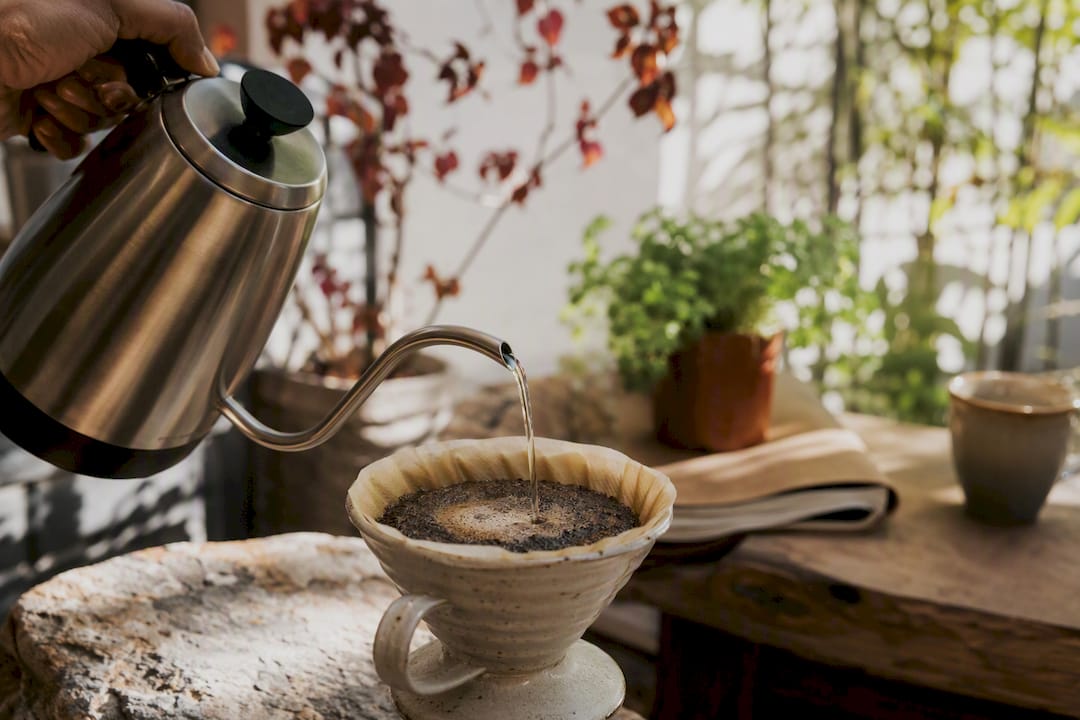
Flow rate matters more than most home brewers realize. Gooseneck kettles typically pour at 2 to 10 ml/s versus 30 to 50 ml/s for standard kettles, and that gap is exactly where recipe timing lives. A V60 recipe built around a 45 second bloom and a 2:30 total brew time assumes you can hit those numbers reliably. At 40 ml/s, you blow through the bloom stage before the coffee has even finished off-gassing.
A few extraction-relevant benefits worth naming directly:
- Fewer channels cut through the bed, since a gentle stream doesn’t punch holes in saturated grounds
- More even bed depth after brewing, which you can actually check by looking at the spent grounds
- Tighter cup-to-cup consistency, so a recipe you like doesn’t turn into a coin flip
When Does a Gooseneck Kettle Actually Matter?
Not every brew method rewards this level of control, so it helps to know where the investment pays off and where it doesn’t.
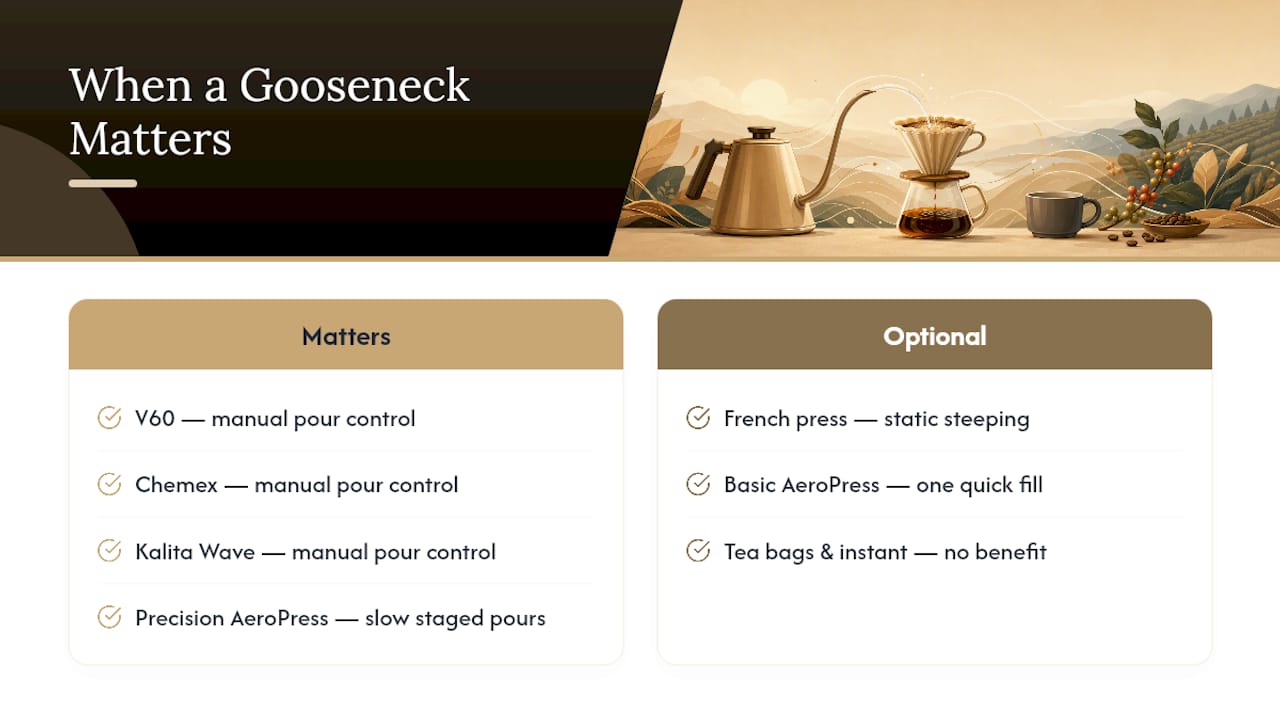
Methods where a gooseneck earns its keep: V60, Chemex, and Kalita Wave all depend on manual pour control, since the brewer, not a machine, decides bloom timing, pour rate, and pour placement. Precision AeroPress recipes that call for slow, staged pours benefit too, especially inverted methods that mimic pour-over timing.
Methods where it’s optional: French press steeps grounds in a static pool, so pour precision barely factors in. A basic AeroPress recipe with one quick fill doesn’t need it either, and boiling water for tea bags or instant coffee gains nothing from a narrow spout.
Ask yourself three questions before buying. How often do you actually brew pour-over? Do you care about hitting the same result twice, or is variety part of the fun? And do you also want built-in temperature control, since that’s a separate feature some gooseneck models bundle in and others don’t. If you brew pour-over most mornings and get frustrated when Tuesday’s cup doesn’t match Sunday’s, you’re the target buyer. A gooseneck also earns its keep as a dual-purpose tool: the same gentle, temperature-accurate pour that helps coffee also protects delicate green and white teas from scalding, so it’s rarely a single-use gadget gathering dust.
Are There Cheaper Alternatives to a Gooseneck Kettle?
You don’t strictly need a gooseneck to brew good pour-over, but the alternatives ask more of you in exchange for less money. A regular kettle paired with a large spoon, pouring a thin stream off the edge of the spoon into the dripper, can approximate some of the control at zero extra cost. It works, but it’s slower to learn, harder to sustain across a full pour, and nearly impossible to do one-handed while timing a brew.
A temperature-controlled standard kettle solves half the problem. You get accurate heat, which matters, but you’re still fighting a wide spout that dumps water rather than placing it. For pour-over specifically, spout geometry tends to matter more than temperature precision alone.
On price, basic stovetop gooseneck kettles start affordably, while electric models with digital temperature control and hold functions sit at a moderate premium over a standard electric kettle. That premium buys you temperature accuracy that removes the guesswork of judging water heat by sound or steam.
A quick buy or skip checklist:
- Brew pour-over three or more times a week? Buy.
- Mostly drink French press or drip machine coffee? Skip, or borrow one occasionally.
- Want built-in temperature control too? Look at electric gooseneck models specifically.
- Tight budget and only an occasional pour-over habit? Try the spoon trick first.
How Do You Pour With a Gooseneck for V60 Coffee?
Getting the technique right matters more than the kettle itself, though the kettle is what makes the technique possible in the first place.
Start with your setup: water heated to somewhere in the 195 to 205°F range, your dose weighed, grind set medium-fine for V60, and your dripper rinsed and seated over your cup or server on a scale.
- Bloom: Pour roughly twice your coffee’s weight in water (about 40g for a 20g dose), starting from the center and spiraling out gently. Start your timer at zero.
- Wait: Let the bed sit for 30 to 45 seconds, watching for the “bloom” of bubbles as trapped gas escapes.
- First pulse pour: Pour in a slow spiral from center to edge, bringing total water to roughly 60% of your target weight, finishing around the 1:00 mark.
- Second pulse pour: Repeat the spiral, bringing total water to your full target, aiming to finish pouring by around 1:45.
- Drawdown: Let the remaining water drain through, targeting a total brew time between 2:30 and 3:00.
A sample timeline for a 20g dose, 320g total water: bloom to 40g at 0:00, first pour to 200g by 1:00, second pour to 320g by 1:45, full drawdown by 2:45.
Pro Tip: Keep your wrist loose and your elbow doing the work, not your fingers. Beginners tend to grip the handle tightly and pour in short, jerky bursts, which is the fastest way to agitate the bed too much and pull bitter, over-extracted notes into the cup.
The two mistakes that show up most often: pouring too fast because it feels more efficient, and pouring in one continuous stream from bloom to finish instead of pulsing. Both undercut the entire reason you bought the kettle.
What Features Actually Matter in a Gooseneck Kettle?
Not every feature on a spec sheet affects your brew. A few genuinely do.
- Temperature control and hold: lets you set a target and walk away without reboiling, which matters most on electric models.
- Wattage and heat-up speed: higher wattage means less waiting between cups if you’re brewing for a household.
- Stainless steel interior: avoids exposed plastic touching near-boiling water, a detail worth checking on budget models.
- Capacity around 0.8 to 1.0 liters: enough for one or two pour-overs without reheating, without being so large it’s slow to heat.
- Spout aperture size: a well-balanced spout meets somewhere between an ultra-slow trickle and enough flow to keep pours from dragging on.
- Handle ergonomics: a comfortable grip matters more than it sounds during a two-minute pour held at an angle.
For upkeep, descale every few weeks if you’re in a hard-water area, and rinse the spout opening after each use so mineral buildup doesn’t narrow or distort your stream over time. A kettle that pours unevenly because of scale buildup defeats the entire purpose of owning one.
Why Does Pour-Over Feel Like a Ritual With a Gooseneck?
There’s a psychological layer here that rarely gets mentioned alongside the mechanics. Baristas often report that the slower, more deliberate pace a gooseneck demands turns brewing into something closer to a calming routine than a task. You can’t rush a gooseneck pour the way you can dump water from a regular kettle, and that forced patience tends to sharpen focus on the details that actually matter, like bloom timing and pour placement.
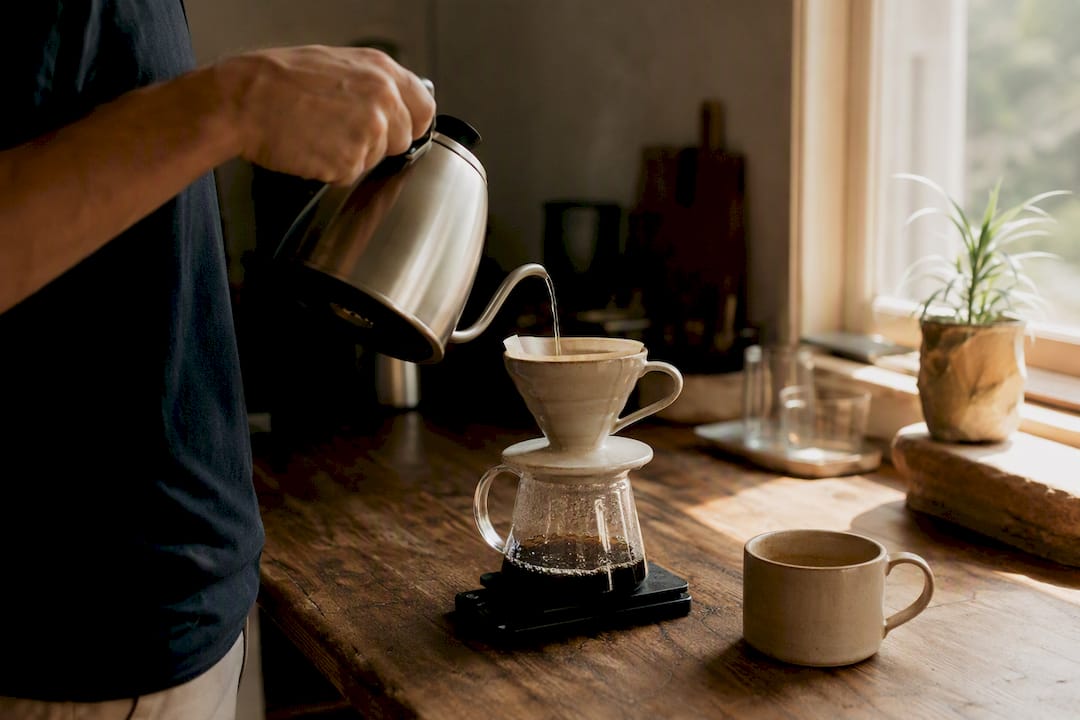
This isn’t separate from the mechanical benefits. It’s what makes them repeatable morning after morning.
Pro Tip: Run a tempo drill with plain water: pour for exactly 30 seconds, aiming to hit a target weight on your scale. Repeat it daily for a week. You’ll build a physical sense of pace that translates directly into steadier bloom and pulse pours.
A Home Barista’s Case for the Gooseneck
I’d recommend a gooseneck to anyone who brews pour-over more than a couple of times a week, without much hesitation. The gap between a controlled pour and a guessed one is the difference between a recipe you can trust and one you’re constantly troubleshooting. Where I’d skip it: if your daily habit is drip coffee or French press and pour-over is an occasional weekend project, save the money and put it toward better beans instead.
That’s worth saying plainly, because gear only gets you so far. A precise pour on a mediocre, stale roast still tastes like a mediocre, stale roast. Pairing better technique with specialty beans sourced with real traceability, the kind of direct-trade coffee Rowst builds its catalog around, is where the two investments actually compound.
Pair Your Pour-Over Skills With Beans Worth the Effort
A gooseneck kettle only shows its value when there’s something worth extracting carefully, and that means fresh, well-sourced beans with flavor notes distinct enough to notice the difference between a rushed pour and a controlled one. Rowst sources single-origin coffee directly from small-scale producers in regions like Uganda, El Salvador, and Mexico, so the terroir differences your new pouring technique reveals are actually there to find.

If you’re curious how your pour-over skills translate across different origins, the Discovery Pack offers a range of profiles in smaller quantities, ideal for testing how bloom timing and pour rate change the cup depending on the bean. For a deeper dive once you’ve settled into your technique, the Coffee Lover Pack rotates through Rowst’s curated single-origins and blends. Either one gives your new gooseneck routine something worth brewing.
Frequently Asked Questions
Does a gooseneck kettle actually make a difference in taste?
Yes, indirectly. The kettle itself doesn’t add flavor, but it lets you control bloom saturation, pour rate, and water placement, all of which directly affect how evenly your coffee extracts. Poor extraction shows up as sourness or bitterness, so better control tends to produce a cleaner, more balanced cup.
Is a gooseneck kettle worth the cost for a casual coffee drinker?
If you brew pour-over only occasionally, the cost is harder to justify, and a spoon-assisted pour from a regular kettle can get you most of the way there. If pour-over is part of your regular routine, the consistency gain typically justifies the price difference over a standard kettle.
Do I need an electric gooseneck, or is stovetop enough?
Stovetop models handle the core benefit, precise flow control, just fine and cost less. Electric models add built-in temperature control and hold, which matters more if you brew multiple methods or want to skip using a separate thermometer.
Can I use a gooseneck kettle for tea as well as coffee?
Yes. The same gentle, controllable pour that benefits coffee extraction also helps with delicate teas, since green and white teas in particular are sensitive to both water temperature and pour speed. A temperature-controlled gooseneck is genuinely a dual-purpose tool, not just a coffee accessory.
What size gooseneck kettle should I buy?
Most home brewers do well with a 0.8 to 1.0 liter capacity, enough for one or two pour-overs without needing a reheat, while still heating up reasonably fast. Larger households brewing several cups back to back may prefer higher capacity paired with higher wattage.