

How to Store Coffee Beans and Keep Them Fresh
Keep whole beans airtight, cool, and away from light — and grind just before brewing. That single habit protects more flavor than any canister you can buy. For storing coffee beans at home, three actions matter most right now:
- Keep beans in their original one-way valve bag (pressed to remove air) or transfer to an opaque airtight canister.
- Store in a cool, dark cabinet — away from your stove, oven, or any window.
- Buy only what you can finish in 1–2 weeks for peak flavor.
The sections below cover short-term routines, long-term freezer protocols, container comparisons, and shelf-life timelines so you can match the right method to your actual habits.
Key Takeaways
Whole beans stored airtight, cool, and dark — and ground only at brew time — stay at peak flavor for 1–2 weeks after opening, with properly frozen portions lasting a month or longer.
| Point | Details |
|---|---|
| Airtight and dark is the baseline | Store beans in an opaque airtight container or resealed one-way valve bag, away from heat and light. |
| Peak window after opening | Whole beans stay at their best for 1–2 weeks; ground coffee fades within 3–5 days. |
| Freeze only in single-use portions | Portion before freezing, thaw sealed to room temperature, and never refreeze after opening. |
| Match container to consumption pace | Daily drinkers need only the original bag; occasional drinkers benefit from a vacuum or displacement canister. |
| Rowst packs fit the 1–2 week window | The Coffee Lover Pack and Discovery Pack are sized for home brewers who want fresh beans without bulk buying. |
Table of Contents
- Why does storage affect how your coffee tastes?
- How to store beans after opening for the first two weeks
- Which coffee storage container is right for your habits?
- When should you freeze coffee beans, and how do you do it right?
- How long do whole beans and ground coffee stay at their best?
- How to choose the right storage method for your routine
- Research-backed container picks and why they hold up
- Why freshness is personal at Rowst
- Fresh beans, sized for how you actually brew
- Sources
Why does storage affect how your coffee tastes?
Loss of volatile aromatic compounds and oxidation are what make coffee taste flat. The moment beans are roasted, they begin releasing CO₂ in a process called degassing. That outgassing CO₂ actually creates a temporary barrier against oxygen for the first week or two after roast. Once it dissipates, oxygen moves in and starts breaking down the delicate compounds responsible for brightness, sweetness, and complexity.
Four specific enemies accelerate that breakdown:
- Air oxidizes aromatic oils and dulls flavor.
- Moisture triggers hydrolysis, turning beans stale and musty.
- Heat speeds up every chemical reaction that degrades coffee.
- Light (especially UV) breaks down chlorogenic acids and aromatic esters.
Professional roasters point to grinding immediately before brewing as the single biggest habit change you can make, because ground coffee exposes far more surface area to oxygen and loses aromatic compounds almost instantly.
Pro Tip: Freshly roasted espresso beans benefit from a few days of rest before brewing — CO₂ still escaping from very fresh beans can cause uneven extraction. Darker roasts degas faster than light roasts, so they also go stale faster. If you buy dark-roast beans, plan to use them within 10–14 days of opening.
How to store beans after opening for the first two weeks
For the 0–2 week window, the original one-way valve bag — pressed to remove excess air before resealing — is often the best option most home brewers have. Coffee experts consistently confirm that for anyone finishing a bag within 1–2 weeks, that original bag provides strong protection without any additional purchase.
What to do:
- Leave whole beans whole until the moment you brew.
- Squeeze air from the bag before rolling it down and resealing with the built-in clip or a binder clip.
- Store in a cool, dark cabinet — a pantry shelf or upper cabinet away from the stove works well.
- Use beans within 1–2 weeks of opening for the clearest, most expressive flavor.
What to avoid:
- The refrigerator. Coffee is hygroscopic and will absorb moisture and ambient food odors.
- Clear countertop canisters placed near a window or under direct kitchen lighting.
- Pre-grinding more than you need for a single session.
Pro Tip: When you open a fresh bag, consider portioning it immediately. Divide a 12 oz bag into two portions — keep one accessible in a small canister and fold the rest tightly in the original bag. You minimize headspace and reduce how often the main supply is exposed to air.
Here is a quick step-by-step for resealing correctly:
- Remove only the beans you need for your current brew.
- Press the bag flat from the bottom up to push out trapped air.
- Roll the top down tightly two or three times.
- Secure with the bag’s built-in tin tie or a strong binder clip.
- Place in a cabinet away from heat and light sources.
Which coffee storage container is right for your habits?
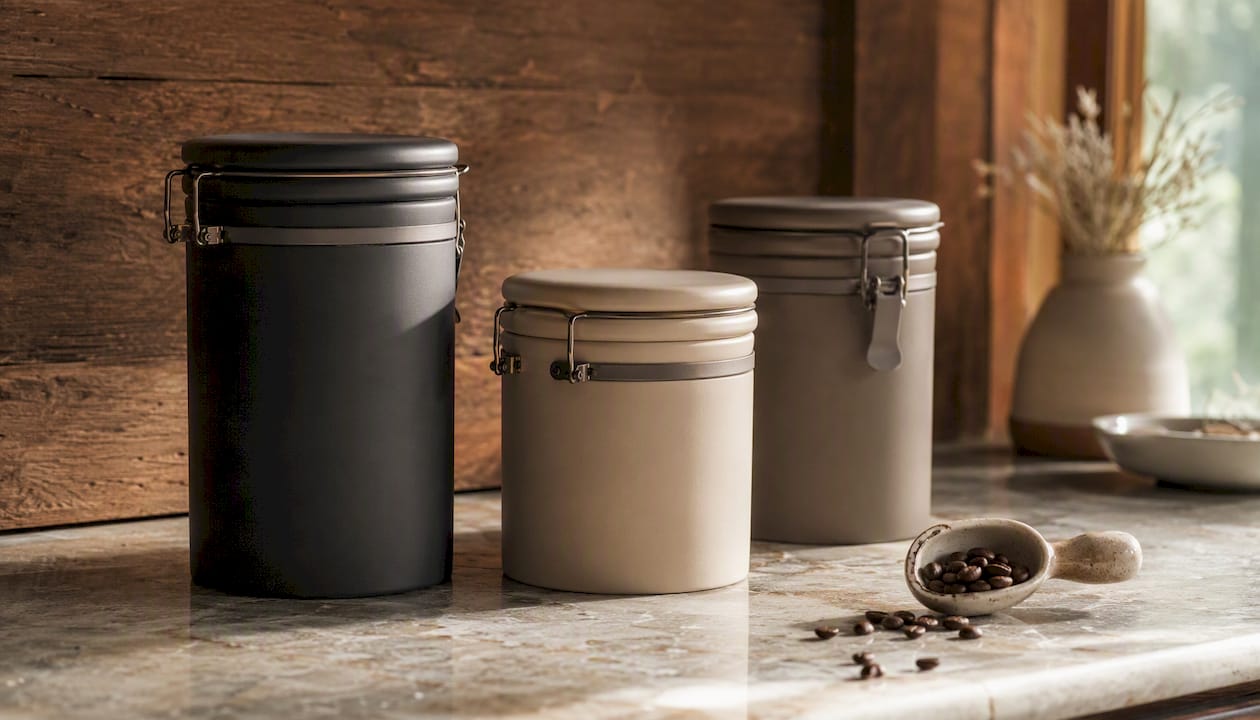
The right container depends on how quickly you go through a bag and whether you store whole beans or ground coffee. Daily drinkers finishing a bag relatively quickly get modest gains from premium canisters. Occasional drinkers or those buying specialty lots in bulk benefit considerably more from vacuum or displacement-style containers.
Category exemplars worth knowing:
- Fellow Atmos Vacuum Canister uses a twist-and-lock pump lid to pull oxygen out of the container. It performs well for whole beans, but its intake valve can clog with fine grounds — keep it for whole-bean storage.
- OXO Brew Coffee Storage Container offers a push-button airtight seal with a UV-blocking opaque body. It is straightforward to use daily and works well for both whole beans and ground coffee.
- Airscape Kilo (Planetary Design) uses a displacement lid that physically pushes down onto the beans, forcing air out through a one-way valve. The Kilo size holds up to 1 lb of whole beans, making it practical for larger purchases.
- Coffee Gator Airtight Canister is a stainless steel, opaque canister with a CO₂ release valve and date-tracking wheel. It handles both whole beans and grounds and sits at a mid-range price point.
- MiiR Airlock Coffee Canister combines a vacuum-seal mechanism with a clean, minimal aesthetic. It is a strong choice for specialty beans you want to protect for up to a few weeks.
Glass containers are fine if kept in a dark cabinet. On a counter, opaque stainless steel is preferable because it blocks both light and ambient heat more reliably than glass.
When should you freeze coffee beans, and how do you do it right?
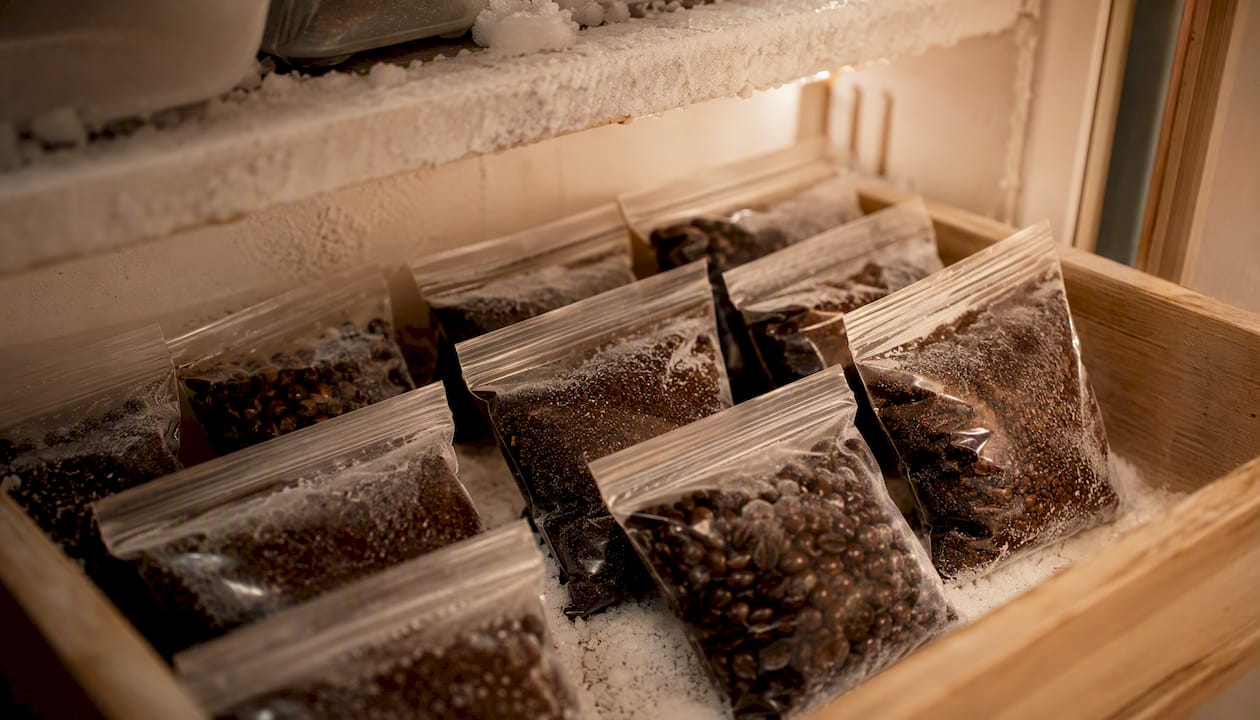
Freeze only for true long-term storage — weeks to months — and only if you will not access those beans daily. Freezing done correctly preserves freshness remarkably well. Done carelessly, it introduces moisture and off-flavors that no brewing technique can fix.
The core rule of freezing coffee: portion before you freeze, and never return thawed beans to the freezer. Each thaw–refreeze cycle causes condensation to form on the beans, and that moisture accelerates staling faster than room-temperature storage would.
Follow these steps for safe long-term freezing:
- Divide beans into single-use portions sized for one to two brewing sessions.
- Pack each portion into a vacuum-sealed bag or a truly airtight, moisture-proof freezer bag with as little headspace as possible.
- If freezing an unopened roaster bag, tape over the one-way valve to prevent air ingress as the packaging expands in the cold.
- Label each portion with the roast date and freeze immediately.
- When ready to use, remove one portion and let it thaw to room temperature while still sealed — this prevents condensation from forming on the beans themselves.
- Once thawed, use within 1–2 weeks and never refreeze.
The Kitchn’s guidance on freezing confirms that single-use portioning and avoiding repeated thaw–refreeze cycles are the two non-negotiable steps. The National Coffee Association adds that refrigeration — as opposed to freezing — is generally a bad idea because coffee absorbs moisture and odors from the fridge environment even through sealed packaging.
Freezing makes the most sense when you receive a limited-release single-origin lot, buy in bulk to save cost, or want to preserve a special bag for a future occasion.
How long do whole beans and ground coffee stay at their best?
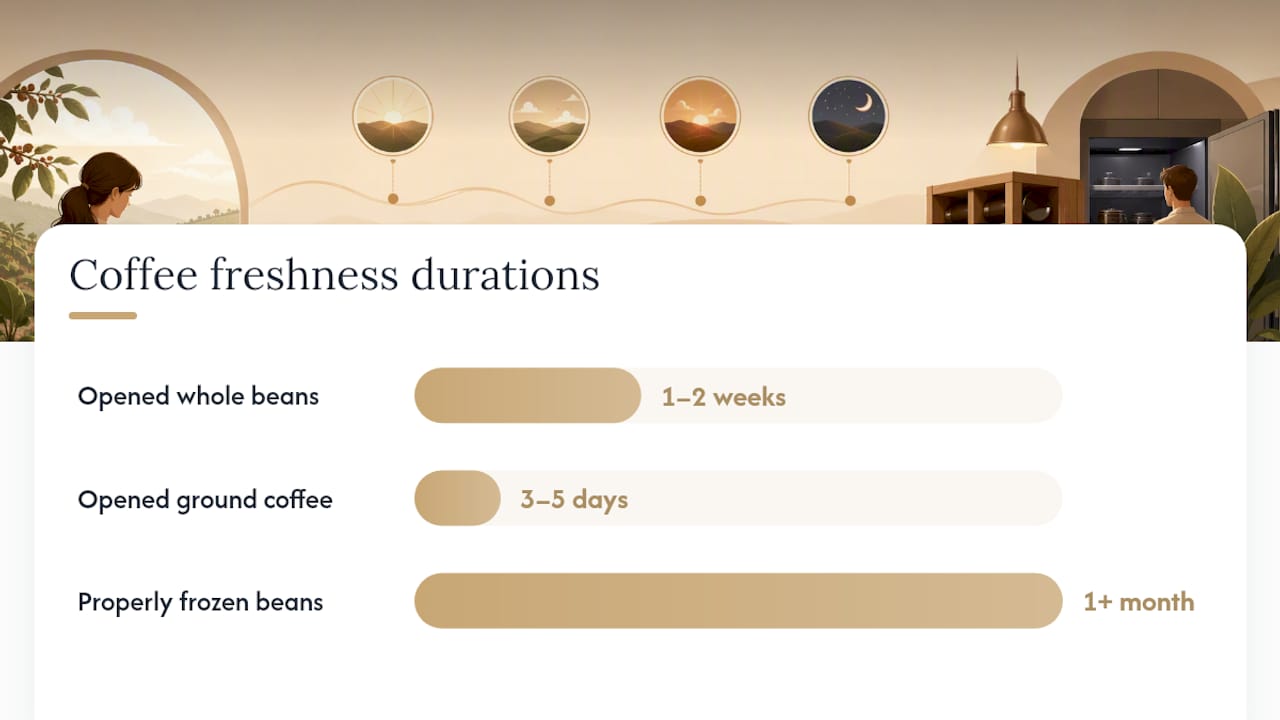
Whole beans stay fresh considerably longer than ground coffee. The practical windows below assume proper airtight, cool, dark storage throughout.
| Coffee State | Peak Flavor Window | Notes |
|---|---|---|
| Unopened roasted bag | Up to the printed best-by date | One-way valve bags slow oxidation; use within 2–4 weeks of that date once opened |
| Opened whole beans | 1–2 weeks | Industry educators note peak freshness is often about one week after opening |
| Opened ground coffee | 3–5 days | Surface area loss is rapid; buy small and grind fresh |
| Refrigerated (not recommended) | Shorter than room-temperature | Moisture and odor absorption offset any temperature benefit |
| Properly frozen (portioned, airtight) | Up to 1 month or longer | Single-use portions only; never refreeze after thawing |
A few factors shift these windows meaningfully:
- Roast level: Darker roasts degas faster and go stale sooner than light or medium roasts. If you favor dark-roast beans, tighten your purchase cycle.
- Grind timing: Grinding accelerates aroma loss dramatically. A whole bean that would stay vibrant for two weeks becomes noticeably flat within a few days once ground.
- Headspace: A half-empty canister holds more oxygen than a full one. Match your container size to your typical purchase quantity.
How to choose the right storage method for your routine
Choose based on how fast you go through a bag and where you keep it in your kitchen. The right method costs nothing extra if you already have a good original bag.
Match your habit to a method:
- Daily drinker (finishing a bag in under two weeks): The original one-way valve bag, properly resealed, is sufficient. A small opaque airtight canister adds convenience without meaningfully extending freshness at this pace.
- Occasional drinker (a bag lasts 3–4 weeks): A vacuum or displacement canister, like the Fellow Atmos or Airscape Kilo, is worth the investment. Reduced oxygen contact makes a real difference over that longer window.
- Long-term keeper (buying in bulk or preserving a special lot): Vacuum-seal and freeze in single-use portions. Follow the thaw protocol above.
- Ground coffee user: Buy the smallest available quantity, store in an airtight opaque container, and use within 3–5 days.
Red flags to watch for:
- A clear glass canister sitting on a sunlit counter.
- Any container stored on a shelf directly above or beside the stove.
- A large canister that is only one-third full — excess headspace means excess oxygen.
- Returning thawed beans to the freezer after opening.
Pro Tip: Before buying a new canister, measure your typical weekly consumption. If you brew one to two cups daily, a 12 oz bag lasts roughly a week. A 16 oz canister sized to that quantity keeps headspace minimal and freshness high without any extra effort.
Research-backed container picks and why they hold up
Vacuum and displacement-style canisters consistently outperform basic airtight lids in blind tastings and canister testing because they actively reduce the oxygen in contact with beans rather than simply slowing its entry. The difference is most pronounced for specialty beans with delicate aromatic profiles — the kind where you paid for nuance and want to taste it.
The practical takeaway from canister testing: for daily drinkers, the original bag beats most canisters on cost and convenience. For anyone stretching a bag beyond two weeks, a vacuum or displacement canister preserves the gap between “fresh” and “fine.”
Short notes on each tested category:
- Fellow Atmos Vacuum Canister: The twist-pump mechanism removes oxygen actively. Best for whole beans stored over 2–3 weeks. Avoid using it with ground coffee — fine particles can clog the intake valve and break the seal.
- OXO Brew Coffee Storage Container: Push-button airtight seal with a UV-blocking body. Reliable for daily use, easy to clean, and compatible with both whole beans and grounds. A strong everyday choice.
- Airscape Kilo: The inner plunger lid physically displaces air as it descends, which is a mechanically elegant solution. The Kilo’s 1 lb capacity suits home brewers who buy in standard roaster quantities.
- Coffee Gator Airtight Canister: The date-tracking wheel is a genuinely useful feature — it removes the guesswork about when you opened the bag. Works well for both bean types at a mid-range price.
- MiiR Airlock Coffee Canister: Clean design with a functional vacuum seal. A good fit for specialty beans you want to protect for up to a few weeks, particularly if aesthetics matter to you.
Pro Tip: Match container capacity to your purchase size. A 1 lb canister for a 12 oz bag leaves too much headspace. Either buy a smaller canister or keep the remainder in the original bag until the canister is nearly empty.
Why freshness is personal at Rowst
At Rowst, we source in small batches from producers in Uganda, El Salvador, and Mexico precisely because volume and freshness are in tension. Large lots sit longer. Small, direct-sourced batches move faster from roast to your cup, which means the storage advice in this guide actually has something worth protecting.
Every bag we ship carries a roast date, not a vague best-by estimate, so you can apply the timelines above with real precision. Our curated packs are sized for one- to two-week consumption windows — the sweet spot where the original bag or a small canister is all you need, and the flavor you paid for is still fully intact.
Fresh beans, sized for how you actually brew
If you prefer to buy in quantities that align with the 1–2 week freshness window, Rowst’s Coffee Lover Pack is portioned exactly for that rhythm — a curated selection of single-origin specialty beans sized so you finish each bag at peak flavor without needing a freezer or a premium canister.
Each pack includes roast-date transparency and beans sourced directly from small-scale producers, so you know exactly what you are working with from the moment it arrives. For those who want to explore before committing to a single origin, the Discovery Pack offers a range of flavor profiles in smaller quantities — ideal for matching a new origin to your preferred brew method before buying a full bag.
Browse Rowst’s full selection and find the pack that fits your weekly ritual.
Sources
- I Asked Coffee Experts How to Keep Beans Fresh—They All Said the Same Thing
- The Right Way to Store Coffee, According to a Professional Roaster
- Coffee Science: How to store coffee beans for freshest flavor at home
- The Best Way to Store Coffee Beans for Maximum Freshness | The Kitchn
- Storage and shelf life - Beans - NCA