

5 Checks Before You Buy Coffee: Rainforest Alliance vs Fairtrade
Fairtrade protects farmer income through a guaranteed minimum price and a cash premium paid to cooperatives. Rainforest Alliance focuses on environmental and social standards, backed by a mandatory buyer payment called the Sustainability Differential rather than a fixed floor price. See a Fairtrade seal, and you’re looking at a price safety net; see the Rainforest Alliance frog, and you’re looking at verified farm practices. Both rely on third-party audits and belong to the ISEAL Alliance, the body that sets credibility standards for sustainability certifications.
TL;DR:
- Fairtrade provides a guaranteed minimum price and a premium directly invested in community projects, protecting farmers from market crashes.
- Rainforest Alliance emphasizes environmental and social standards with a certification that does not include a price floor, relying instead on audits and sustainability standards.
- The two labels target different issues: Fairtrade secures income stability, while Rainforest Alliance focuses on farm environmental practices.
- Certification alone offers a baseline trust; building relationships with specific farms provides greater accountability and transparency.
- Consumers should prioritize knowing the actual farm or cooperative behind the product and look for detailed sourcing information for more ethical choices.
Table of Contents
- Rainforest Alliance vs Fair Trade: the Side-by-Side Breakdown
- How Rainforest Alliance Certification Actually Works
- How Fairtrade Certification Actually Works
- Weighing the Real-World Impact of Each Label
- How to Choose Coffee When You Care About the Farmer
- Why We Think Certification and Relationship Both Matter
- Where to Find Ethically Sourced Coffee You Can Trace
- Sources
Rainforest Alliance vs Fair Trade: the Side-by-Side Breakdown
The two labels solve different problems, and once you see them side by side, the choice stops feeling like guesswork.
| Criteria | Rainforest Alliance | Fairtrade |
|---|---|---|
| Primary focus | Environmental and social farm standards | Price security and community investment |
| Payment model | Sustainability Differential and Sustainability Investments (buyer-funded, no fixed floor) | Minimum Price plus Fairtrade Premium paid into a cooperative fund |
| Environmental standards | Deforestation limits, biodiversity protection, climate-smart farming | Baseline environmental criteria, less prescriptive than RA |
| Who gets certified | Farms, plantations, and cooperatives | Primarily smallholder cooperatives |
| Audit and verification | Independent third-party audits | Independent third-party audits |
| Seal content threshold | Roughly 90% certified content for single-ingredient products | No fixed content percentage; based on sourcing volume |
| Typical farmer benefit | Farm infrastructure and training investment | Predictable income floor and community project funding |
A few things jump out once you compare them directly; for example, plantations like Kona’s Mountain Thunder Coffee Plantation in the Cloud Forest illustrate how environmental standards apply in practice:
- If price volatility keeps you up at night on behalf of farmers, Fairtrade’s floor price is the more direct answer.
- If you care more about deforestation, water use, and biodiversity on the farm itself, Rainforest Alliance’s standards go deeper.
- Neither label guarantees better-tasting coffee. Both simply verify different promises.
- Many roasters stack the two, or add direct-trade premiums on top of either, to cover the gaps each program leaves open.
How Rainforest Alliance Certification Actually Works
Rainforest Alliance built its 2020 certification program around three pillars: social, environmental, and economic. But the environmental piece carries the most weight in practice. Farms are audited on deforestation avoidance, water management, agrochemical use, and worker protections, with climate resilience woven through nearly every requirement.
The economic mechanism surprises a lot of shoppers. Instead of a fixed minimum price, Rainforest Alliance requires buyers to pay a Sustainability Differential, a mandatory cash amount on top of market price, plus optional Sustainability Investments that fund farm-level projects like erosion control or shade-tree planting.
Seal rules matter too. A single-ingredient product, like a bag of whole-bean coffee, generally needs a high percentage of certified content to carry the frog logo, according to Rainforest Alliance’s own certification guidance.
Pro Tip: Look for a lot number or origin cooperative name on the bag. A certified seal with no traceable origin tells you less than the seal alone suggests.
Watchdog groups have pushed back hard on one point: Rainforest Alliance doesn’t require a democratic cooperative structure or a price floor, which Fair World Project argues creates real confusion between “environmentally certified” and “fair trade.”
- Criticism: Consumers often assume the frog logo means the same worker protections as Fairtrade.
- Criticism: Plantations, not just smallholder co-ops, can qualify, which changes who actually benefits from certification.
- Response: RA’s 2020 program added the Sustainability Differential specifically to address income criticism.
How Fairtrade Certification Actually Works
Fairtrade’s entire model rests on two mechanisms: the Minimum Price and the Fairtrade Premium. The Minimum Price acts as a floor, insulating farmers from crashes in the commodity market. The Premium is a fixed additional payment, and cooperative members vote democratically on how to spend it, whether that’s a health clinic, a school, or farm equipment, according to Fairtrade International.
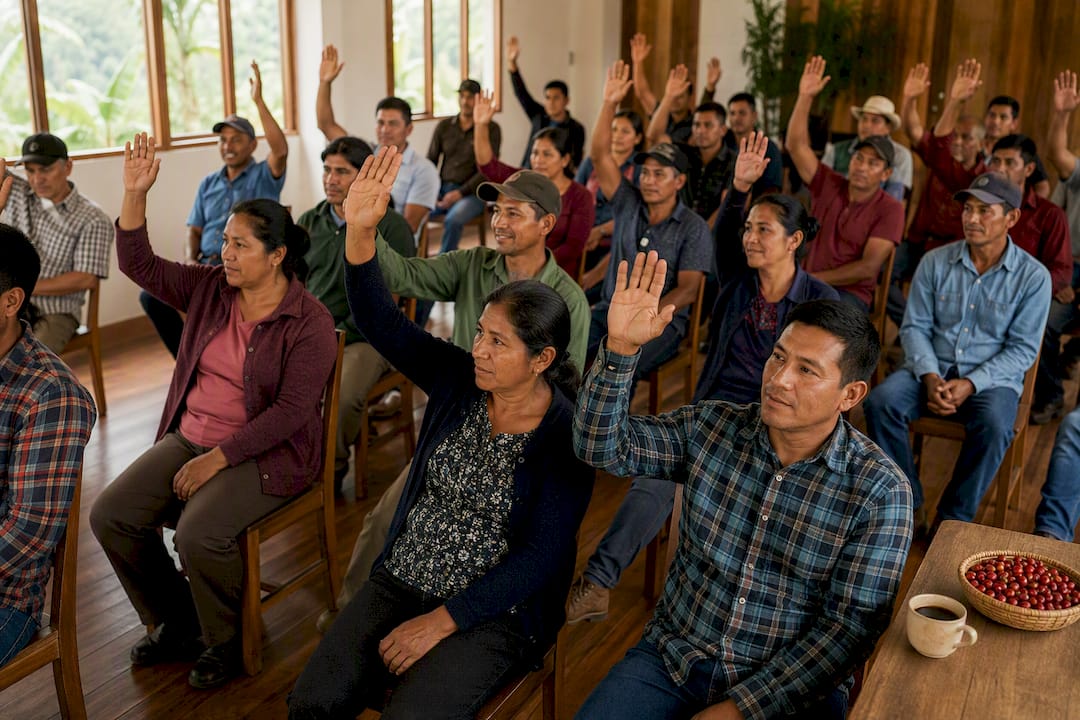
Fairtrade primarily certifies cooperatives rather than individual farms or large plantations, which is a structural difference worth knowing. Fair Trade USA operates a related but separate labeling system in North America, with some differences in scope, so the seal you see on a US shelf isn’t always issued by the same body as the one common in Europe.
Strengths and limits both deserve airtime here:
- Strength: A price floor protects farmers when global coffee prices drop, which happens often and unpredictably.
- Strength: Cooperative governance means the community decides how premium funds get spent, not a distant buyer.
- Limit: Critics note the floor price doesn’t always keep pace with farmers’ actual cost of living.
- Limit: Certification applies at the cooperative level, so individual farm practices within a co-op can vary widely.
Weighing the Real-World Impact of Each Label
Neither program solves the same problem, so comparing “effectiveness” head-to-head misses the point. Fairtrade delivers predictability. Rainforest Alliance delivers documented environmental improvement funded by buyers rather than guaranteed by a floor price. Comparative research from Lund University frames this as a genuine trade-off between income safety nets and investment-based development, not a case of one model simply outperforming the other.
Certification and direct trade aren’t rivals, either. A roaster can buy Fairtrade-certified beans and still pay above the minimum for an exceptional lot, layering a quality premium on top of the baseline protection. That hybrid approach shows up often among roasters who want both verified standards and a reason to reward the best coffee on the table.
Where the disagreement gets sharper is in how each label is perceived. Fair World Project’s critique centers on the claim that Rainforest Alliance lacks the trade-specific protections Fairtrade guarantees, and that the two seals get conflated by shoppers reading labels quickly in a store aisle.
- Watch for: articles or roasters using “sustainable” and “fair trade” interchangeably. They aren’t.
- Watch for: claims of “supporting farmers” with no mention of price, premium, or audit body.
- The honest takeaway: read both labels as answers to different questions, not competing scores on the same test.
How to Choose Coffee When You Care About the Farmer
Start by naming your actual priority. Do you care more about a farmer earning a stable income, or about the environmental footprint of the farm itself? That answer alone should point you toward Fairtrade or Rainforest Alliance before you even read a bag.
- Check the roaster’s sourcing page first, before the certification seal. A page naming specific farms or cooperatives tells you more than a logo alone.
- Look for a stated purchase price or premium disclosure. Roasters proud of what they pay usually say so.
- Confirm the certification body behind the seal, whether that’s Fairtrade International, Fair Trade USA, or Rainforest Alliance, since scope and rules differ.
- Favor roasters who publish lot traceability, not just a country of origin.
- Treat “direct trade” claims with a healthy dose of skepticism unless the roaster names farms and shows repeat-season relationships, since direct trade has no governing body or audit requirement.
Pro Tip: A bag that names the farm, the altitude, and the harvest year is usually more transparent than one that only carries a certification logo and nothing else.
Red flags worth walking away from: vague “sustainably sourced” language with zero audit reference, suspiciously low prices paired with ethical claims, or a certification seal with no traceability information anywhere on the packaging or website.
Why We Think Certification and Relationship Both Matter
Certifications solve a real problem: they let you trust a claim you can’t personally verify. But they’re a floor, not a ceiling. The most interesting sourcing decisions happen above that floor, in the relationships roasters build with individual farms over multiple harvests.
The tension people miss is this: Rainforest Alliance and Fairtrade were both built to standardize trust at scale, which means they sometimes trade away the specificity that a named farm relationship provides. A cooperative-level Fairtrade certification tells you the group meets a floor price. It doesn’t tell you which farm within that cooperative grew the exceptional lot in your cup. That’s not a flaw in the certification model. It’s simply what standardization is built to do, and it’s why pairing certification with direct, traceable sourcing relationships tends to surface more accountability than either approach alone.
Verification and relationship aren’t competing strategies. The strongest sourcing decisions use both: a certification for the floor, and a named, repeat relationship for everything above it.
— Diego
Where to Find Ethically Sourced Coffee You Can Trace
If reading all this has you wanting a cup that matches your values, Rowst built its entire sourcing model around the transparency this comparison keeps circling back to. Rowst works directly with small-scale producers, skipping the layers of intermediaries that make traceability so hard to verify in the first place.

That direct relationship means every purchase rewards the people who actually grew, harvested, and sorted your beans, not just a supply chain further removed from the farm. Rowst’s single-origin specialty coffee collection includes:
- Single-origin coffees highlighting a specific farm or region’s flavor profile
- Curated blends built for everyday ritual without losing traceability
- Discovery packs for exploring multiple origins side by side
Curious how Rowst approaches sourcing beyond the bag? Visit Rowst’s homepage to see the full range and pick a bag that matches the priority this article helped you name.
Sources
- Fairtrade Premium overview - Fairtrade International
- What ‘Direct Trade’ Means for the Farmer Who Grew Your Coffee - CoffeeGeek
- Rainforest Alliance Is Not Fair Trade - Fair World Project